
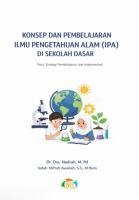
Konsep Dan Pembelajaran Ilmu Pengetahuan Alam (IPA) Di Sekolah Dasar Teori, Strategi Pembelajaran, Dan Implementasi
Synopsis
SPESIFIKASI BUKU
Harga : Rp 165.000
Ukuran : 18 x 25cm
Jumlah Halaman : 329 hal
Ketebalan Buku : 1 cm
ISBN : On Proses
Deskripsi Buku : Buku ini disusun sebagai salah satu upaya untuk memberikan kontribusi dalam pengembangan pembelajaran Ilmu Pengetahuan Alam (IPA) di tingkat Sekolah Dasar, khususnya dalam mendukung implementasi Kurikulum Merdeka dan penguatan Profil Pelajar Pancasila. Ilmu Pengetahuan Alam (IPA) merupakan salah satu mata pelajaran fundamental yang berperan penting dalam membentuk cara berpikir ilmiah, kritis, dan sistematis pada peserta didik sejak usia dini. Oleh karena itu, pembelajaran IPA di Sekolah Dasar tidak hanya menekankan pada penguasaan konsep, tetapi juga pada pengembangan keterampilan proses sains serta pembentukan sikap ilmiah yang bertanggung jawab terhadap lingkungan dan kehidupan. Buku ini disusun secara sistematis mulai dari hakikat IPA, pendekatan dan model pembelajaran, hingga pembahasan materimateri pokok seperti makhluk hidup, benda dan sifatnya, gaya dan gerak, sistem organ, serta perubahan dan pelestarian lingkungan.
REFERENSI :
Akmalia, H. A. (2021). Adaptasi anatomis tumbuhan terhadap perbedaan stres lingkungan. Stigma. Diakses dari https://jurnal.unipasby.ac.id/stigma/article/download/3491/2770/10849
Baron-Cohen, S. (2002). The extreme male brain theory of autism. Trends in Cognitive Sciences, 6(6), 248–254. https://doi.org/10.1016/S1364-6613(02)01904-6
Barnes, P. J. (2019). Cellular and molecular mechanisms of chronic obstructive pulmonary disease. Clinics in Chest Medicine, 40(4), 599–610. https://doi.org/10.1016/j.ccm.2019.07.003
Bioedutech. (2023). Tumbuhan: Morfologi, anatomi, fisiologi, reproduksi dan perkembangan. Bioedutech: Jurnal Biologi, Pendidikan Biologi, dan Teknologi Kesehatan, 2(2), 193–203. https://doi.org/10.572349/biedutech.v2i2.1687
Bybee, R. W. (2013). The case for STEM education: Challenges and opportunities. NSTA Press.
Campbell, N. A., Urry, L. A., Cain, M. L., Wasserman, S. A., Minorsky, P. V., & Reece, J. B. (2018). Biology (11th ed.). Pearson Education.
Craig, A. D. (2009). How do you feel—now? The anterior insula and human awareness. Nature Reviews Neuroscience, 10(1), 59–70. https://doi.org/10.1038/nrn2555
Curtis, H., & Barnes, N. S. (2005). Biology (8th ed.). Pearson Education.
Falla, D., Gizzi, L., Tschapek, M., Erlenwein, J., & Petzke, F. (2020). Reduced respiratory efficiency during voluntary breathing in patients with chronic low back pain. Clinical Biomechanics, 80, 105146. https://doi.org/10.1016/j.clinbiomech.2020.105146
Foster, J. A., & Neufeld, K. A. M. (2013). Gut–brain axis: How the microbiome influences anxiety and depression. Trends in Neurosciences, 36(5), 305–312. https://doi.org/10.1016/j.tins.2013.01.005
Gazzaniga, M. S., Ivry, R. B., & Mangun, G. R. (2018). Cognitive neuroscience: The biology of the mind (5th ed.). W. W. Norton & Company.
Karyati, dkk. (2019). Karakteristik morfologis dan anatomis daun tumbuhan herba pada intensitas cahaya berbeda. Jurnal Biologi Indonesia, 13(1), 1–14.
Mayer, E. A., & Tillisch, K. (2011). The brain–gut axis in abdominal pain syndromes. Annual Review of Medicine, 62, 381–396. https://doi.org/10.1146/annurev-med012309-103958
National Research Council. (2012). A framework for K–12 science education: Practices, crosscutting concepts, and core ideas. The National Academies Press. https://doi.org/10.17226/13165
Odum, E. P., & Barrett, G. W. (2005). Fundamentals of ecology (5th ed.). Thomson Brooks/Cole.
Porges, S. W. (2011). The polyvagal theory: Neurophysiological foundations of emotions, attachment, communication, and self-regulation. W. W. Norton & Company.
Pratiwi, S. (2019). Adaptasi struktural dan fungsional organ reproduktif pada tumbuhan. Seminar Nasional Pendidikan Biologi.
Purves, W. K., Sadava, D., Orians, G. H., & Heller, H. C. (2004). Life: The science of biology (7th ed.). Sinauer Associates.
Qin, J., Li, Y., Cai, Z., et al. (2012). A metagenome-wide association study of gut microbiota in type 2 diabetes. Nature, 490(7418), 55–60. https://doi.org/10.1038/nature11450
Ramachandran, V. S., & Hirstein, W. (1998). The perception of phantom limbs: The D. O. Hebb lecture. Brain, 121(9), 1603–1630. https://doi.org/10.1093/brain/121.9.1603
Raven, P. H., Johnson, G. B., Mason, K. A., Losos, J. B., & Singer, S. R. (2014). Biology (10th ed.). McGraw-Hill Education.
Resnick, M., & Siegel, D. (2015). The role of technology in the science classroom. In N. G. Lederman & S. K. Abell (Eds.), Handbook of research on science education (Vol. 2, pp. 373–391). Routledge.
Sadava, D., Hillis, D. M., Heller, H. C., & Berenbaum, M. R. (2017). Life: The science of biology (11th ed.). W. H. Freeman and Company.
Sari, R. V. (2012). Variasi morfologi tanaman kepel (Stelechocarpus burahol Hook. f. & Thomson) yang tumbuh pada ketinggian berbeda (Skripsi). Universitas Airlangga.
Sonnenburg, J. L., & Bäckhed, F. (2016). Diet–microbiota interactions as moderators of human metabolism. Nature, 535(7610), 56–64. https://doi.org/10.1038/nature18846
Sugandi, Y., & Yanti, D. (2018). Pengembangan buku ajar karakteristik morfologi tumbuhan untuk mahasiswa. Jurnal Basicedu, 2(2), 193–203.
Tang, W. H., Wang, Z., Levison, B. S., et al. (2013). Intestinal microbial metabolism of phosphatidylcholine and cardiovascular risk. New England Journal of Medicine, 368(17), 1575–1584. https://doi.org/10.1056/NEJMoa1109400
Tang, Y. Y., Hölzel, B. K., & Posner, M. I. (2015). The neuroscience of mindfulness meditation. Nature Reviews Neuroscience, 16(4), 213–225. https://doi.org/10.1038/nrn3916
Trefil, J., & Hazen, R. M. (2016). The sciences: An integrated approach (8th ed.). Wiley.
Turnbaugh, P. J., Ley, R. E., Hamady, M., et al. (2007). The human microbiome project. Nature, 449(7164), 804–810. https://doi.org/10.1038/nature06244
Varela, F. J., Thompson, E., & Rosch, E. (2016). The embodied mind: Cognitive science and human experience. MIT Press.
Wang, L., Liu, J., Ma, H., & Zhang, H. (2023). Epigenetic regulation in bone metabolism and its involvement in osteoporosis. International Journal of Molecular Sciences, 24(5), 4245. https://doi.org/10.3390/ijms24054245
Whelton, P. K., Carey, R. M., Aronow, W. S., et al. (2018). 2017 ACC/AHA guideline for the prevention, detection, evaluation, and management of high blood pressure in adults. Journal of the American College of Cardiology, 71(19), e127–e248. https://doi.org/10.1016/j.jacc.2017.11.006
Xu, K., Gao, X., Xia, G., Chen, M., & Zhu, H. (2022). Short-chain fatty acids and bone metabolism. Frontiers in Endocrinology, 13, 867741. https://doi.org/10.3389/fendo.2022.867741
Zhou, J., Liu, Y., Huang, W., Liu, J., & Wang, Q. (2021). The emerging role of the gut–lung axis in respiratory diseases. Frontiers in Immunology, 12, 745855. https://doi.org/10.3389/fimmu.2021.745855
Published
February 25, 2026
Copyright (c) 2026 Perkumpulan Rumah Cemerlang Indonesia
Details about the available publication format: Pratinjau Buku
Pratinjau Buku
Physical Dimensions
Details about the available publication format: Beli Buku
Beli Buku


