
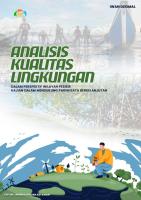
Analisis Kualitas Lingkungan Dalam Perspekstif Wilayah Pesisir : Kajian Dalam Mendukung Kemandirian Pariwisata
Synopsis
SPESIFIKASI BUKU
Harga : Rp 115.000
Ukuran : 18 x 25 cm
Jumlah Halaman : 200 hal
Ketebalan Buku : 2 cm
ISBN : 978-634-239-393-2
Deskripsi Buku :
Tujuan buku ini adalah menyederhanakan konsep-konsep kompleks menjadi panduan bagi mahasiswa dan praktisi yang terjun di bidang analisis kualitas lingkungan dalam perspektif wilayah pesisir, serta memperluas wawasan tentang bagaimana kualitas lingkungan mempengaruhi daya tarik wisata, ekonomi lokal, dan lingkungan hidup. Ruang lingkup materi mencakup konsep dasar, karakteristik pesisir, komponen kualitas lingkungan, parameter dan indikator, metode analisis, serta kebijakan dan pengelolaan.
References
Alongi, D. M. (2009). Mangrove forests: An ecosystem function perspective. CRC Press.
Alongi, D. M. (2009). Mangrove forests: Ecology, management and conservation. CRC Press.
Alongi, D. M. (2014). Mangrove forests: Resilience, protection from tsunamis, and responses to global climate change. Estuarine, Coastal and Shelf Science, 149, 11–22. https://doi.org/10.1016/j.ecss.2014.05.002
Anderson, D. M., Glibert, P. M., & Burkholder, J. M. (2012). Harmful algal blooms and eutrophication: Nutrient sources, composition, and consequences. Estuaries and Coasts, 35(4), 821–847. https://doi.org/10.1007/s12237-012-9493-9
APHA. (2017). Standard methods for the examination of water and wastewater (23rd ed.). American Public Health Association.
Bird, E. C. F. (2008). Coastal geomorphology: An introduction. John Wiley & Sons.
Borja, A., Dauer, D. M., & Josefson, A. B. (2016). Benthic indices and their applications. In Coastal and marine environmental science (pp. 1–12). Springer. https://doi.org/10.1007/978-3-319-27746-1_100-1
Brown, R. M., McClelland, N. I., Deininger, R. A., & Tozer, R. G. (1970). A water quality index—Do we dare? Water & Sewage Works, 117(10), 339–343.
Burke, L., Reytar, K., Spalding, M., & Perry, A. (2011). Reefs at risk revisited. World Resources Institute.
Burton, G. A., Santschi, P. H., & Zhang, S. (2019). Sediment quality criteria for coastal environments: A review of approaches and challenges. Environmental Science & Technology, 53(18), 10509–10524. https://doi.org/10.1021/acs.est.9b02789
Carroll, A. B. (2016). Carroll’s pyramid of CSR: Taking another look. International Journal of Corporate Social Responsibility, 1(1), 3. https://doi.org/10.1186/s40991-016-0004-6
Charmasson, S., & Morel, A. (2009). Salinity. In Encyclopedia of ocean sciences (2nd ed., pp. 1–10). Academic Press. https://doi.org/10.1016/B978-012374473-9.00693-8
Chen, Y., Li, J., & Li, Y. (2020). Big data in environmental monitoring and management: A review. Environmental Science and Pollution Research, 27(1), 1–15. https://doi.org/10.1007/s11356-019-06612-3
Chen, Y., Wang, Y., & Wang, J. (2016). Heavy metal contamination in coastal soils and sediments: A review. Environmental Science and Pollution Research, 23(1), 1–15. https://doi.org/10.1007/s11356-015-5467-6
Christie, P., Lowry, K., White, A. T., Oracion, E. G., Sieben, C. J., Pomeroy, R. S., & Bechler, K. (2005). Key lessons from a decade of coastal management in the Philippines. Coastal Management, 33(3), 333–344. https://doi.org/10.1080/08920750590952044
Cicin-Sain, B., & Knecht, R. W. (1998). Integrated coastal and ocean management: Concepts and practices. Island Press.
Clark, J. R. (1996). Coastal zone management handbook. CRC Press.
Cole, S. (2012). Tourism and the community: A critical analysis of the social impacts of tourism. Routledge.
Costanza, R., d’Arge, R., de Groot, R., Farber, S., Grasso, M., Hannon, B., et al. (1997). The value of the world’s ecosystem services and natural capital. Nature, 387(6630), 253–260. https://doi.org/10.1038/387253a0
Costanza, R., de Groot, R., Braat, L., Kubiszewski, I., Fioramonti, L., Sutton, P., et al. (2017). Twenty years of ecosystem services: How far have we come and how far do we still need to go? Ecosystem Services, 28, 1–16. https://doi.org/10.1016/j.ecoser.2017.09.008
Dewi, N. P. S., Yuliantari, N. P. S., & Suardana, I. W. (2023). Implementasi higiene dan sanitasi makanan pada restoran di kawasan pariwisata Ubud. Jurnal Ilmiah Pariwisata dan Bisnis, 2(1), 1–10. https://doi.org/10.55606/jipb.v2i1.1023
Diaz, R. J., & Rosenberg, R. (2008). Spreading dead zones and consequences for marine ecosystems. Science, 321(5891), 926–929. https://doi.org/10.1126/science.1156401
Doney, S. C., Fabry, V. J., Feely, R. A., & Kleypas, J. A. (2009). Ocean acidification: The other CO₂ problem. Annual Review of Marine Science, 1, 169–192. https://doi.org/10.1146/annurev.marine.010908.163834
Elliott, M., & Quintino, V. (2007). The estuarine quality paradox. Marine Pollution Bulletin, 54(1), 2–5. https://doi.org/10.1016/j.marpolbul.2006.10.010
Elliott, M., Mander, L., Mazik, K., & Misiak, W. (2016). Marine and coastal ecosystems and human well-being. Springer.
Erftemeijer, P. L. A., Riegl, B., Hoeksema, B. W., & Todd, P. A. (2012). Environmental impacts of dredging on corals. Marine Pollution Bulletin, 64(9), 1737–1765. https://doi.org/10.1016/j.marpolbul.2012.05.008
Eriksen, M., Lebreton, L. C. M., Carson, H. S., et al. (2014). Plastic pollution in the world's oceans. PLoS ONE, 9(12), e111913. https://doi.org/10.1371/journal.pone.0111913
European Environment Agency. (2017). Environmental indicators: Typology and overview. EEA.
FAO. (2020). The state of world fisheries and aquaculture 2020. FAO.
Fauzi, A., & Anna, S. (2013). Community-based ecotourism development. Journal of Coastal Conservation, 17(2), 295–306. https://doi.org/10.1007/s11852-012-0230-0
Fauzi, A., & Anna, S. (2019). Ekonomi sumber daya alam dan lingkungan. Gramedia.
Ferrario, F., Beck, M. W., Storlazzi, C. D., et al. (2014). Coral reefs for coastal protection. Nature Communications, 5, 3794. https://doi.org/10.1038/ncomms4794
Ferraro, P. J., & Kiss, A. (2002). Costs of conservation projects. Conservation Biology, 16(4), 974–984.
GESAMP. (2015). Microplastics in the marine environment.
Gibson, R. B. (2017). Sustainability assessment. Routledge.
Gössling, S., Peeters, P., & Hall, C. M. (2018). Tourism and environmental change. In Routledge handbook of tourism and sustainability.
Hadi, S. P. (2017). Aspek lingkungan dalam pembangunan berkelanjutan. UGM Press.
Hall, C. M., & Page, S. J. (2014). The geography of tourism and recreation (4th ed.). Routledge.
Halpern, B. S., et al. (2008). Human impact on marine ecosystems. Science, 319, 948–952.
Hughes, T. P., et al. (2018). Coral reefs in the Anthropocene. Nature, 556, 328–336.
IPCC. (2021). Climate change 2021: The physical science basis. Cambridge University Press.
Jamal, T. B., & Getz, D. (1995). Collaboration theory in tourism. Annals of Tourism Research, 22(1), 186–204.
Kementerian Lingkungan Hidup dan Kehutanan. (2009). UU No. 32 Tahun 2009.
Kementerian Lingkungan Hidup dan Kehutanan. (2021). PP No. 22 Tahun 2021.
Koelmans, A. A., et al. (2019). Plastic fragmentation. Environmental Science & Technology, 53(12), 6777–6785.
Mangubhai, S., et al. (2012). Marine protected areas. Coastal Management, 40(4), 401–419.
Masselink, G., & Hughes, M. (2014). Introduction to coastal geomorphology. Routledge.
Miller, G., & Twining-Ward, L. (2019). Tourism and SDGs. Routledge.
Nicholls, R. J., & Cazenave, A. (2010). Sea-level rise. Science, 328, 1517–1520.
OECD. (2010). Glossary of key terms in evaluation.
Orth, R. J., et al. (2006). Seagrass crisis. BioScience, 56(12), 987–996.
Pandolfi, J. M., et al. (2003). Coral reef decline. Science, 301, 955–958.
Pethick, J. (1984). Coastal geomorphology. Edward Arnold.
Pomeroy, R. S., et al. (2005). MPA evaluation guidebook. IUCN.
UNEP. (2017). Marine litter: A global challenge.
UNWTO. (2017). Tourism and the SDGs.
WCED. (1987). Our common future. Oxford University Press.
WHO. (2017). Guidelines for safe recreational water environments.
Woodroffe, C. D. (2002). Coasts: Form, process and evolution. Cambridge University Press.
Wright, S. L., Thompson, R. C., & Galloway, T. S. (2013). Microplastics impacts. Environmental Pollution, 178, 483–492.
Published
April 13, 2026
Copyright (c) 2026 Perkumpulan Rumah Cemerlang Indonesia
Details about the available publication format: Pratinjau Buku
Pratinjau Buku
Physical Dimensions
Details about the available publication format: Beli Buku
Beli Buku


