
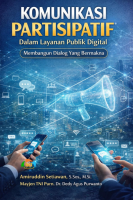
Komunikasi Partisipatif Dalam Layanan Publik Digital Membangun Dialog Yang Bermakna
Synopsis
SPESIFIKASI BUKU
◉ Harga : Rp 75.000
◉ Ukuran : 15,5 x 23 cm
◉ Jumlah Halaman : 131 hal
◉ Ketebalan Buku : 1 cm
◉ ISBN : On Proses
◉ Deskripsi Buku : Buku ini disusun sebagai bahan ajar dan referensi bagi mahasiswa, khususnya pada Program Studi Ilmu Komunikasi, dalam memahami dinamika komunikasi partisipatif di era transformasi digital yang terus berkembang. Perkembangan teknologi digital telah mengubah cara pemerintah dan masyarakat berinteraksi. Komunikasi publik tidak lagi bersifat satu arah, melainkan berkembang menjadi dialog yang melibatkan partisipasi aktif masyarakat. Oleh karena itu, buku ini hadir untuk memberikan pemahaman teoretis sekaligus praktis mengenai konsep, strategi, serta implementasi komunikasi partisipatif dalam layanan publik digital. Penulis berharap buku ini dapat membantu pembaca dalam memahami pentingnya membangun komunikasi yang inklusif, transparan, dan berorientasi pada kebutuhan masyarakat.
REFERENSI :
Bryson, J. M. (2020). Strategic Planning for Public and Nonprofit Organizations (5th ed.). Wiley.
Bucher, T. (2020). If... Then: Algorithmic Power and Politics. Oxford University Press.
Carpentier, N. (2020). The Discursive-Material Knot: Cyprus in Conflict and Community Media Participation. Peter Lang.
Coombs, W. T. (2021). Ongoing Crisis Communication: Planning, Managing, and Responding (5th ed.). Sage Publications.
Couldry, N., & Mejias, U. A. (2019). The Costs of Connection: How Data is Colonizing Human Life and Appropriating It for Capitalism. Stanford University Press.
Flew, T. (2021). Media and Communication in the Digital Age. Polity Press.
Flick, U. (2020). An Introduction to Qualitative Research (6th ed.). Sage Publications.
Fuchs, C. (2021). Social Media: A Critical Introduction (3rd ed.). Sage Publications.
Fung, A. (2020). Deliberative democracy and public participation. Annual Review of Political Science, 23, 1–18.
Garrett, J. J. (2021). The Elements of User Experience: User-Centered Design for the Web and Beyond (2nd ed.). New Riders.
Gillespie, T. (2020). Custodians of the Internet: Platforms, Content Moderation, and the Hidden Decisions That Shape Social Media. Yale University Press.
Grunig, J. E. (2020). Excellence in Public Relations and Communication Management. Routledge.
Janowski, T. (2020). Digital government evolution: From transformation to contextualization. Government Information Quarterly, 37(1), 101385.
Kent, M. L., & Taylor, M. (2021). Dialogic communication theory in digital contexts. Public Relations Review, 47(2), 102012.
Kitchin, R. (2020). The Data Revolution: Big Data, Open Data, Data Infrastructures and Their Consequences (2nd ed.). Sage Publications.
Kurniawan, T. (2021). Transformasi Digital dan Inovasi Pelayanan Publik di Indonesia. Prenadamedia Group.
Littlejohn, S. W., Foss, K. A., & Oetzel, J. G. (2021). Theories of Human Communication (12th ed.). Waveland Press.
Luna-Reyes, L. F., & Gil-Garcia, J. R. (2021). Digital government transformation and internet portals: The co-evolution of technology, organizations, and institutions. Government Information Quarterly, 38(1), 101540.
Manyozo, L. (2021). Media, Communication and Development: Three Approaches (2nd ed.). Sage Publications.
McQuail, D., & Deuze, M. (2020). McQuail’s Media and Mass Communication Theory (7th ed.). Sage Publications.
Medaglia, R., & Zheng, L. (2021). Mapping government social media research and moving it forward: A framework and a research agenda. Government Information Quarterly, 38(2), 101552.
Meijer, A., & Bolívar, M. P. R. (2019). Governing the smart city: A review of the literature on smart urban governance. International Review of Administrative Sciences, 85(2), 392–408.
Mergel, I., Edelmann, N., & Haug, N. (2019). Defining digital transformation: Results from expert interviews. Government Information Quarterly, 36(4), 101385.
Mossberger, K., Tolbert, C. J., & McNeal, R. S. (2021). Digital Citizenship: The Internet, Society, and Participation. MIT Press.
Nabatchi, T., & Leighninger, M. (2015). Public Participation for 21st Century Democracy. Jossey-Bass.
Norman, D. A. (2021). Design for a Better World: Meaningful, Sustainable, Humanity Centered. MIT Press.
Reed, M. S. (2020). A theory of participation: What makes stakeholder and public engagement in environmental management work? Restoration Ecology, 28(S1), S7–S17.
Robinson, L. (2020). Digital inequalities and why they matter. Information, Communication & Society, 23(3), 1–16.
Sari, D. P., & Prasetyo, B. (2022). Digital governance dan partisipasi publik dalam layanan pemerintahan berbasis elektronik. Jurnal Ilmu Komunikasi, 20(2), 115–130.
Servaes, J. (2020). Handbook of Communication for Development and Social Change. Springer.
Tufte, T., & Mefalopulos, P. (2020). Participatory Communication: A Practical Guide. World Bank Publications.
van Dijk, J. (2020). The Digital Divide. Polity Press.
Waisbord, S. (2020). Communication: A Post-Discipline. Polity Press.
Wirtz, B. W., & Müller, W. M. (2021). An integrated artificial intelligence framework for public management. Public Management Review, 23(7), 1076–1100.
Wirtz, B. W., Weyerer, J. C., & Rösch, M. (2019). Citizen and open government: An empirical analysis of antecedents of open government data. International Journal of Public Administration, 42(4), 308–320.
Published
April 17, 2026
Copyright (c) 2026 Perkumpulan Rumah Cemerlang Indonesia
Details about the available publication format: Pratinjau Buku
Pratinjau Buku
Physical Dimensions
Details about the available publication format: Beli Buku
Beli Buku


