
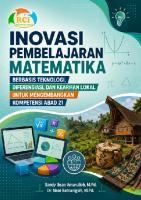
Inovasi Pembelajaran Matematika Berbasis Teknologi, Diferensiasi, Dan Kearifan Lokal Untuk Mengembangkan Kompetensi Abad 21
Synopsis
SPESIFIKASI BUKU
Harga : Rp 185.000
Ukuran : 18 cm x 25 cm
Jumlah Halaman : 462 hal
Ketebalan Buku : 1 cm
ISBN : On Proses
Deskripsi Buku : Buku ini disusun sebagai bentuk kontribusi akademik dalam menjawab tantangan pembelajaran matematika di era abad ke-21 yang menuntut adanya inovasi, adaptasi teknologi, serta pendekatan pembelajaran yang berpusat pada kebutuhan peserta didik. Perkembangan zaman yang begitu pesat menuntut pendidik untuk tidak hanya menyampaikan materi, tetapi juga mampu merancang pengalaman belajar yang bermakna, inklusif, dan kontekstual. Secara keseluruhan, buku ini terdiri atas 17 bab yang mengkaji berbagai inovasi dalam pembelajaran matematika. Setiap bab ditulis oleh penulis yang memiliki latar belakang dan kepakaran di bidangnya masingmasing, sehingga menghadirkan perspektif yang beragam dan komprehensif. Pembahasan dalam buku ini mencakup penggunaan media pembelajaran berbasis teknologi seperti Scratch, Augmented Reality, Flipbook, iSpring Suite, Adobe Animate, hingga platform digital lainnya yang mendukung proses pembelajaran yang interaktif dan efektif. Selain itu, buku ini juga mengangkat berbagai pendekatan pedagogis inovatif seperti pembelajaran berdiferensiasi, Problem Based Learning (PBL), pendekatan metakognitif, Discovery Learning, serta integrasi STEM dan Culturally Responsive Teaching (CRT). Pendekatan-pendekatan tersebut diharapkan mampu mengakomodasi keberagaman karakteristik peserta didik serta meningkatkan kualitas proses dan hasil pembelajaran.
REFERENSI :
Batdı, V., Doğan, Y., & Talan, T. (2021). Effectiveness of problem-based learning on students’ academic achievement, attitudes, and higher-order thinking skills: A meta-analysis. Educational Research Review, 33, 100395. https://doi.org/10.1016/j.edurev.2021.100395
Batdı, V., Talan, T., & Semerci, C. (2021). Meta-analytic and thematic analysis of problem-based learning studies. Journal of Education and Training Studies, 9(1), 22–36. https://doi.org/10.11114/jets.v9i1.5032
Capraro, R. M., & Slough, S. W. (2021). Project-based and problem-based learning: An integrated approach. Sense Publishers.
Chen, L., & Yang, Y. (2023). Effects of problem-based learning on students’ mathematical thinking, motivation, and learning outcomes: A meta-analytic review. Educational Research Review, 38, 100513. https://doi.org/10.1016/j.edurev.2022.100513
Drijvers, P., Kieran, C., & Mariotti, M. A. (2022). Problem-based learning and inquiry in mathematics education: Trends, challenges, and teacher roles. ZDM–Mathematics Education, 54(2), 217–230. https://doi.org/10.1007/s11858-021-01327-7
English, L. D., & Kirshner, D. (2023). Mathematical problem solving, modelling, and problem-based learning in the 21st century. Educational Studies in Mathematics, 112(1), 1–20. https://doi.org/10.1007/s10649-022-10152-0
Hmelo-Silver, C. E., & Jeong, H. (2021). Problem-based learning and inquiry: Design features and implementation. Instructional Science, 49(1), 1–25. https://doi.org/10.1007/s11251-020-09515-6
Hung, W. (2021). Designing authentic problems for problem-based learning: The 3C3R model. Interdisciplinary Journal of Problem-Based Learning, 15(1), 1–15. https://doi.org/10.14434/ijpbl.v15i1.28890
Leary, H., Walker, A., Shelton, B. E., & Fitt, M. H. (2022). Instructional scaffolding and learning outcomes in problem-based learning environments. Educational Technology Research and Development, 70(3), 1329–1352. https://doi.org/10.1007/s11423-021-10066-2
Li, Y., Kaiser, G., Stillman, G., & Schukajlow, S. (2024). Mathematical modelling competency development through problem-based learning. International Journal of Science and Mathematics Education, 22(2), 345–367. https://doi.org/10.1007/s10763-023-10372-6
Loyens, S. M. M., Kirschner, P. A., & Paas, F. (2023). Problem-based learning: Cognitive and motivational processes revisited. Educational Psychology Review, 35(1), 1–29. https://doi.org/10.1007/s10648-022-09678-6
OECD. (2021a). Beyond academic learning: First results from the survey of social and emotional skills. OECD Publishing. https://doi.org/10.1787/92a11084-en
OECD. (2021b). Innovating education and educating for innovation: The power of digital technologies and skills. OECD Publishing. https://doi.org/10.1787/829d0a1c-en
OECD. (2021c). PISA 2021 mathematics framework. OECD Publishing. https://doi.org/10.1787/13c8dc0a-en
Savery, J. R. (2021). Overview of problem-based learning: Definitions and distinctions. Interdisciplinary Journal of Problem-Based Learning, 15(2), 1–8. https://doi.org/10.14434/ijpbl.v15i2.30976
Schukajlow, S., Kaiser, G., & Stillman, G. (2022). Promoting mathematical modelling competencies through problem-based learning. Educational Studies in Mathematics, 109(1), 1–24. https://doi.org/10.1007/s10649-021-10072-3
Stacey, K. (2022). Mathematical literacy and problem-based learning: Current perspectives. Journal of Mathematical Behavior, 66, 100948. https://doi.org/10.1016/j.jmathb.2022.100948
Tan, O. S. (2023). Problem-based learning innovation: Pedagogical implications for mathematics education. Asia Pacific Journal of Education, 43(2), 245–260. https://doi.org/10.1080/02188791.2022.2053812
Widjaja, W., Dolk, M., & Fauzan, A. (2024). Developing mathematical reasoning and communication through problem-based learning: International perspectives. International Journal of Science and Mathematics Education, 22(1), 1–21. https://doi.org/10.1007/s10763-023-10349-5
Published
May 5, 2026
Copyright (c) 2026 Perkumpulan Rumah Cemerlang Indonesia
Details about the available publication format: Pratinjau Buku
Pratinjau Buku
Physical Dimensions
Details about the available publication format: Beli Buku
Beli Buku


