
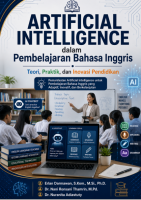
Artificial Intelligence dalam Pembelajaran Bahasa Inggris: Teori, Praktik, dan Inovasi Pendidikan
Synopsis
SPESIFIKASI BUKU
Harga : Rp 65.000
Ukuran : 14,8 cm x 21 cm
Jumlah Halaman : 104 hal
Ketebalan Buku : 1 cm
ISBN : On Proses
Deskripsi Buku : Buku ini disusun sebagai salah satu upaya untuk memperkaya khazanah literatur mengenai pemanfaatan Artificial Intelligence (AI) dalam pembelajaran bahasa Inggris di sekolah. Perkembangan teknologi digital yang sangat pesat telah membawa perubahan besar dalam berbagai bidang kehidupan, termasuk dunia pendidikan. Kehadiran Artificial Intelligence membuka peluang baru dalam menciptakan pengalaman belajar yang lebih interaktif, adaptif, personal, dan berorientasi pada kebutuhan peserta didik. Dalam konteks pembelajaran bahasa Inggris, teknologi AI menawarkan berbagai kemungkinan untuk mendukung pengembangan keterampilan berbahasa melalui penyediaan umpan balik yang cepat, akses terhadap sumber belajar yang beragam, serta lingkungan belajar yang lebih fleksibel.
REFERENSI :
-
Aldulaijan, A. T., & Almalky, S. M. (2025). The impact of generative AI tools on postgraduate students’ learning experiences: New insights into usage patterns. Journal of Information Technology Education: Research, 24, 1–15.
-
Ali Khan, U., Kauttonen, J., Aunimo, L., & Alamäki, A. V. (2024). A system to ensure information trustworthiness in artificial intelligence-enhanced higher education.
-
Al-Kamzari, F., & Alias, N. (2026). A systematic literature review of artificial intelligence (AI) in secondary school physics: Applications, benefits, and challenges. Interactive Learning Environments, 34(2), 676–693. https://doi.org/10.1080/10494820.2025.xxxxxx
-
Al-Mamary, Y. H., & Alshammari, M. M. (2026). AI chatbots for better or worse? Trust, enjoyment and ethics in AI adoption through a UTAUT lens. Journal of Science and Technology Policy Management, 1–46.
-
Alojail, M. A., Alshehri, J., & Khan, S. B. (2023). Critical success factors and challenges in adopting digital transformation in the Saudi Ministry of Education. Sustainability.
-
Chapman, B. L., Ross, A. S., & Petraki, E. (2026). Teacher readiness for generative AI: A theory of planned behaviour approach. Social Sciences & Humanities Open, 13, 102351.
-
Charles, K. A., Yousuf, A., Chua, H. C., Matthews, S., Harnett, J., & Hinton, T. (2025). AI in action: Changes to student perceptions when using generative artificial intelligence for multimedia project-based assessment. European Journal of Pharmacology, 998, 177508.
-
Cheah, Y. H., Lu, J., & Kim, J. (2025). Integrating generative artificial intelligence in K–12 education: Examining teachers’ preparedness, practices, and barriers. Computers and Education: Artificial Intelligence, 8, 100363.
-
Chen, Z., Wei, W., & Zou, D. (2026). Generative AI technology and language learning: Global language learners’ responses to ChatGPT videos in social media. Interactive Learning Environments, 34(2), 907–920.
-
Cole, R. (2023). Inter-rater reliability methods in qualitative case study research. Sociological Methods & Research. https://doi.org/10.1177/00491241231156971
-
Darmawan, E., Rahman, T. K. A., & Thamrin, N. R. (2024). Evaluating readiness and acceptance of artificial intelligence adoption among elementary school teachers. Jurnal Online Informatika, 9(2), 228–237.
-
Deriba, F. G., & Sanusi, I. T. (2025). Artificial intelligence in Ethiopian school curriculum: Educators’ practices, challenges, and recommendations. Computers and Education Open, 8, 100251.
-
Drolet, M. J., Rose-Derouin, E., Leblanc, J. C., Ruest, M., & Williams-Jones, B. (2023). Ethical issues in research: Perceptions of researchers, research ethics board members and research ethics experts. Journal of Academic Ethics. https://doi.org/10.1007/s10805-022-09455-3
-
Garcia, O. A., García, M. del C. R., & Alonso-Secades, V. (2025). Perceptions, strategies, and challenges of teachers in the integration of artificial intelligence in primary education: A systematic review. Journal of Information Technology Education: Research, 24, 6.
-
Herzallah, A. M., & Makaldy, R. (2025). Technological self-efficacy and sense of coherence: Key drivers in teachers’ AI acceptance and adoption. Computers and Education: Artificial Intelligence, 8, 100377.
-
Hnz, G. (2026). A year of generative AI in English language teaching and learning: A case study. Journal of Research on Technology in Education, 58(2), 291–311.
-
Hsu, H.-L., Lai, S.-L., & Chen, H.-J. H. (2024). Examining in-service senior high school English teachers’ perspectives on corpus use and the effects of corpus training. Applied Corpus Linguistics, 4(3), 100116.
-
Huang, M. (2025). Fuzzy decision support system for English language teaching with corpus data. Egyptian Informatics Journal, 29, 100612.
-
Huang, Y.-N. K., Chang, M.-C., & Liu, S.-Y. (2025). Taiwanese high school students’ perspectives on artificial intelligence and its applications. Computers in Human Behavior Reports, 17, 100550.
-
Kong, S.-C., Cheung, M.-Y. W., & Tsang, O. (2024). Developing an artificial intelligence literacy framework: Evaluation of a literacy course for senior secondary students. Computers and Education: Artificial Intelligence, 6, 100214.
-
Kong, S.-C., Yang, Y., & Hou, C. (2024). Examining teachers’ behavioural intention of using generative artificial intelligence tools. Computers and Education: Artificial Intelligence, 7, 100328.
-
Khoa, B. T., Hung, B. P., & Hejsalem-Brahmi, M. (2023). Qualitative research in social sciences: Data collection, analysis, and report writing. International Journal of Public Sector Performance Management, 12(1–2), 187–209.
-
Law, L. (2024). Application of generative artificial intelligence in language teaching and learning: A scoping review. Computers and Education Open, 6, 100174.
-
Lee, D., et al. (2024). The impact of generative AI on higher education learning and teaching. Computers and Education: Artificial Intelligence, 6, 100221.
-
Lee, S., Choe, H., Zou, D., & Jeon, J. (2026). Generative AI in the language classroom: A systematic review. Interactive Learning Environments, 34(1), 335–359.
-
Lucas, M., Bem-haja, P., Zhang, Y., Llorente-Cejudo, C., & Palacios-Rodríguez, A. (2025). A comparative analysis of pre-service teachers’ readiness for AI integration. Computers and Education: Artificial Intelligence, 8, 100396.
-
McCarthy, A., Maor, D., McConney, A., & Cavanaugh, C. (2023). Digital transformation in education: Critical components for leaders of system change. Social Sciences & Humanities Open.
-
Mukherjee, S., Baral, M. M., Venkataiah, C., Wider, W., & Fauzi, M. A. (2026). A review of the impact of generative AI in education. VINE Journal of Information and Knowledge Management Systems, 56(1), 261–286.
-
Mustofa, R. H., Kuncoro, T. G., Atmono, D., Hermawan, H. D., & Sukirman. (2025). Extending the technology acceptance model: The role of subjective norms, ethics, and trust. Computers and Education: Artificial Intelligence, 8, 100379.
-
Naeem, M., Ozuem, W., Howell, K., & Ranfagni, S. (2023). A step-by-step process of thematic analysis. International Journal of Qualitative Methods, 22.
-
Ramazanoglu, M., & Akin, T. (2025). AI readiness scale for teachers: Development and validation. Education and Information Technologies, 30(6), 6869–6897.
-
Sanusi, I. T., Ayanwale, M. A., & Tolorunleke, A. E. (2024). Investigating pre-service teachers’ AI perception. Computers and Education: Artificial Intelligence, 6, 100202.
-
Tan, X., Cheng, G., & Ling, M. H. (2025). Artificial intelligence in teaching and teacher professional development: A systematic review. Computers and Education: Artificial Intelligence, 8, 100355.
-
Turós, M., Nagy, R., & Szűts, Z. (2025). Secondary school students and AI usage: A survey of attitudes. Computers and Education: Artificial Intelligence, 8, 100394.
-
Yao, N., & Wang, Q. (2024). Factors influencing pre-service teachers’ intention toward AI. Heliyon, 10(14), e34894.
-
Yao, Y., Zhu, X., Xiao, L., & Lu, Q. (2025). AI-guided chatbot in student writing feedback. Journal of Second Language Writing, 67, 101179.
Published
June 7, 2026
Copyright (c) 2026 Perkumpulan Rumah Cemerlang Indonesia
Details about the available publication format: Pratinjau Buku
Pratinjau Buku
Physical Dimensions
Details about the available publication format: Beli Buku
Beli Buku


