
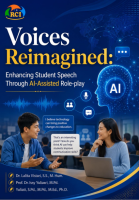
Voices Reimagined: Enhancing Student Speech Through Ai-assisted Role-play
Synopsis
SPESIFIKASI BUKU
Harga : Rp 85.000
Ukuran : 18 cm x 25 cm
Jumlah Halaman : 116 hal
Ketebalan Buku : 1 cm
ISBN : On Proses
Deskripsi Buku : The book Voices Reimagined is here to bring change. The spirit to present a new way of practicing English speaking skills underlies the birth of this book. In my opinion, artificial intelligence (AI) is positioned here not just as a theory, but as a very relevant personal learning partner. Communication skills are key. Learning a language will obviously never be enough if students are only asked to memorize grammar rules or stacks of words. For example, real learning experiences in daily life can actually be felt directly by students through AI-based conversation simulations. Teachers are also helped to create dynamic classrooms. The space for independence is now wide open. Through AI-based roleplaying methods, various situations ranging from practicing negotiation skills to problem-solving can be actively tried by students themselves. In my opinion, a meaningful and not boring learning atmosphere can finally be realized through this adaptive teacher framework. Instant nervousness can collapse. Based on my view from the teacher's point of view in the classroom, practicing in a safe simulation room makes students less afraid of making mistakes when trying to talk to a hotel receptionist or co-worker. Instant corrections are instantly provided privately. As a result, their confidence matured slowly. The future of education has begun. Effectiveness and fun in the process of learning English are no longer impossible thanks to the presence of this technological support of Voices Reimagined. In essence, a bridge to humane and inclusive learning for the rhythm of growth and development of each student has been successfully built.
REFERENSI :
-
A Lee, K., Lim, S.-B., & Nagarajan, N. (2023). A study of the effectiveness of English speaking of teachable agent using AI chatbot. In R. A., S. L., & J. van den H. (Eds.), International Conference on Agents and Artificial Intelligence (Vol. 1, pp. 308–314). Science and Technology Publications, Lda. https://doi.org/10.5220/0011730300003393
-
Adžić, S., Tot, T. S., Vukovic, V., Radanov, P., & Avakumović, J. (2024). Understanding student attitudes toward GenAI tools: A comparative study of Serbia and Austria. International Journal of Cognitive Research in Science, Engineering and Education, 12(3), 123–145. https://doi.org/10.23947/2334-8496-2024-12-3-583-611
-
Ahsan, U., Yusuf, L., Aslam, M., Aslam, A., Nasim, A., & Khan, M. H. (2024). Workplace incivility: Resident’s perspective. Journal of Islamic International Medical College, 19(4), 288–293. https://doi.org/10.57234/jiimc.december24.2079
-
Al-Emran, M. (2024). Unleashing the role of ChatGPT in metaverse learning environments: Opportunities, challenges, and future research agendas. Interactive Learning Environments, 32(10), 7497–7506. https://doi.org/10.1080/10494820.2024.2324326
-
Al Khreshe, M. (2022). Teachers’ perceptions of promoting student-centred learning environment: An exploratory study of teachers’ behaviours in the Saudi EFL context. Journal of Language and Education, 8(3), 23–39. https://doi.org/10.17323/jle.2022.11917
-
Al-obaydi, L. H., Pikhart, M., & Hossain, M. K. (2025). ChatGPT and the development of core language skills: An exploratory study of EFL college students. Contemporary Educational Technology, 17(4), 1–21. https://doi.org/10.30935/cedtech/17242
-
Aljasir, N. (2023). Perceptions of self-learners of English toward mobile language learning: Technology acceptance model and constructivist learning theory perspectives. International Journal of Computer-Assisted Language Learning and Teaching, 13(1). https://doi.org/10.4018/IJCALLT.334599
-
Alrayes, A., Henari, T. F., & Ahmed, D. A. (2024). ChatGPT in education: Understanding the Bahraini academics perspective. Electronic Journal of E-Learning, 22(2, Special Issue), 112–134. https://doi.org/10.34190/EJEL.22.2.3250
-
Altwijri, O., Alsadoon, E., Shahba, A. A.-W., Soufan, W., & Alkathiri, S. (2022). The effect of using student response systems (SRS) on faculty performance and student interaction in the classroom. Sustainability, 14(22). https://doi.org/10.3390/su142214957
-
Alwazzan, M. S. (2023). European Journal of Educational Research, 13(2), 573–584. https://doi.org/10.12973/eu-jer.13.2.573
-
Alwazzan, M. S. (2024). Investigating the effectiveness of artificial intelligence chatbots in enhancing digital dialogue skills for students. European Journal of Educational Research, 13(2), 573–584. https://doi.org/10.12973/eu-jer.13.2.573
-
Avin, S., Gruetzemacher, R., & Fox, J. (2020). Exploring AI futures through role play. In Proceedings of the AAAI/ACM Conference on AI, Ethics, and Society (pp. 8–14). https://doi.org/10.1145/3375627.3375817
-
Ay Kaya, E., & Avara, H. (2025). Education Informatics Network-based blended learning in high school English as a foreign language context. Journal of Learning and Teaching in Digital Age, 10(1), 44–57. https://doi.org/10.53850/joltida.1439275
-
Barrington, K., & Campbell, B. (2008). MUDD mapping: An interactive teaching-learning strategy. Nurse Educator, 33(4), 159–163. https://doi.org/10.1097/01.NNE.0000312195.89438.2b
-
Bekkar, H.-A., & Chtouki, Y. (2024). Chatbots in education: A systematic literature review. In 2024 10th International Conference on Smart Computing and Communication (ICSCC 2024) (pp. 637–644). https://doi.org/10.1109/ICSCC62041.2024.10690334
-
BenMessaoud, F., Bolchini, D., Ash, E., & Tseng, C.-M. (2023). FazBoard: An AI-educational hybrid teaching and learning system. In K. Arai (Ed.), Lecture Notes in Networks and Systems (Vol. 813, pp. 305–315). Springer. https://doi.org/10.1007/978-3-031-47454-5_23
-
Benuyenah, V., & Dewnarain, S. (2024). Students’ intention to engage with ChatGPT and artificial intelligence in higher education business studies programmes: An initial qualitative exploration. International Journal of Distance Education Technologies, 22(1). https://doi.org/10.4018/IJDET.348061
-
Bharathy, M. S. (2013). Effectiveness of roleplay in enhancing speaking skills of tertiary level learners. IOSR Journal of Humanities and Social Science, 13(1), 17–19. https://doi.org/10.9790/0837-1311719
-
Bower, M., Torrington, J., Lai, J. W. M., Petocz, P., & Alfano, M. (2024). How should we change teaching and assessment in response to increasingly powerful generative artificial intelligence? Outcomes of the ChatGPT teacher survey. Education and Information Technologies, 29(12), 15403–15439. https://doi.org/10.1007/s10639-023-12405-0
-
Bozdoğan, D., & Özen, R. (2014). Use of ICT technologies and factors affecting pre-service ELT teachers’ perceived ICT self-efficacy. Turkish Online Journal of Educational Technology, 13(2), 186–196.
-
Bozkurt, A. (2023). Unleashing the potential of generative AI, conversational agents and chatbots in educational praxis: A systematic review and bibliometric analysis of GenAI in education. Open Praxis, 15(4), 261–270. https://doi.org/10.55982/openpraxis.15.4.609
-
Brown, H. D. (2000). Teaching by Principles: An Interactive Approach to Language Pedagogy (2nd ed.). Longman.
-
Brown, H. D., & Abeywickrama, P. (2019). Language Assessment: Principles and Classroom Practices (3rd ed.). Pearson.
-
Brown, L. N., & Howard, A. M. (2014). A real-time model to assess student engagement during interaction with intelligent educational agents. In ASEE Annual Conference and Exposition Proceedings.
-
Brown, H., & Howard, A. (2014). Assessment of engagement for intelligent educational agents: A pilot study with middle school students. Computers in Education Journal, 5(4), 96–106.
-
Busso, A. (2024). Advancing communicative competence in the digital age: A case for AI tools in Japanese EFL education. Technology in Language Teaching and Learning, 6(3). https://doi.org/10.29140/tltl.v6n3.1211
-
Cai, M.-Y., Wang, J.-Y., Chen, G.-D., Wang, J.-H., & Yang, S.-H. (2020). A digital reality theater with the mechanisms of real-time spoken language evaluation and interactive switching of scenario virtual costumes: Effects on motivation and learning performance. In Proceedings of the IEEE 20th International Conference on Advanced Learning Technologies (ICALT 2020) (pp. 295–299). IEEE. https://doi.org/10.1109/ICALT49669.2020.00096
-
Cain, W. (2024a). Supporting AI-enhanced active online learning experiences: A framework for design and assessment. In Handbook of Research in Online Learning: Insights and Advances (pp. 539–551). Brill. https://doi.org/10.1163/9789004702813_023
-
Cain, W. (2024b). Supporting AI-enhanced active online learning experiences: A framework for design and assessment. In Handbook of Research in Online Learning: Insights and Advances. Brill. https://doi.org/10.1163/9789004702813_023
-
Celik, B., Yildiz, Y., & Kara, S. (2025). Using ChatGPT as a virtual speaking tutor to boost EFL learners’ speaking self-efficacy. Australian Journal of Applied Linguistics, 8(1).
-
Chen, A. (2025). Investigating the effect of role-play activity with GenAI agent on EFL students’ speaking performance. Journal of Educational Computing Research, 63(1), 99–125. https://doi.org/10.1177/07356331241299058
-
Chen, C., & Gong, Y. (2025). The role of AI-assisted learning in academic writing: A mixed-methods study on Chinese as a second language students. Education Sciences, 15(2). https://doi.org/10.3390/educsci15020141
-
Chen, K. (2022). The construction of interactive teaching quality monitoring system from the perspective of psychology. Frontiers in Psychology, 13. https://doi.org/10.3389/fpsyg.2022.849528
-
Chen, P. (2022). Design and construction of an interactive intelligent learning system for English learners in higher education institutions. Advances in Multimedia, 2022. https://doi.org/10.1155/2022/6364796
-
Cherrez-Ojeda, I., Gallardo-Bastidas, J. C., Robles-Velasco, K., Osorio, M. F., Velez Leon, E. M., Leon Velastegui, M., Pauletto, P., Aguilar-Díaz, F. C., Squassi, A., González Eras, S. P., Cordero Carrasco, E., Chavez Gonzalez, K. L., Calderon, J. C., Bousquet, J., Bedbrook, A., & Faytong-Haro, M. (2024). Understanding health care students’ perceptions, beliefs, and attitudes toward AI-powered language models: Cross-sectional study. JMIR Medical Education, 10. https://doi.org/10.2196/51757
-
Church, A., & Bateman, A. (2020). Conversation analytic role-play method (CARM) for early childhood teacher education. Teacher Development, 24(5), 652–668. https://doi.org/10.1080/13664530.2020.1820371
-
Cordero, J., Torres-Zambrano, J., & Cordero-Castillo, A. (2025). Integration of generative artificial intelligence in higher education: Best practices. Education Sciences, 15(1). https://doi.org/10.3390/educsci15010032
Published
June 11, 2026
Copyright (c) 2026 Perkumpulan Rumah Cemerlang Indonesia
Details about the available publication format: Pratinjau Buku
Pratinjau Buku
Physical Dimensions
Details about the available publication format: Beli Buku
Beli Buku


