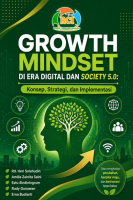
Growth Mindset Di Era Digital Dan Society 5.0: Konsep, Strategi, Dan Implementasi
Synopsis
SPESIFIKASI BUKU
Harga : Rp 350.000
Ukuran : 18 cm x 25 cm
Jumlah Halaman : 559 hal
Ketebalan Buku : 1 cm
ISBN : On Proses
Deskripsi Buku : Perkembangan teknologi digital, kecerdasan buatan (Artificial Intelligence), internet of things, big data, dan berbagai inovasi teknologi lainnya telah membawa perubahan besar dalam berbagai aspek kehidupan manusia. Dunia pendidikan, ekonomi, sosial, politik, budaya, bahkan kehidupan keluarga mengalami transformasi yang sangat cepat. Era Society 5.0 yang berpusat pada manusia (humancentered society) menghadirkan berbagai peluang sekaligus tantangan yang menuntut setiap individu memiliki kemampuan adaptasi, kreativitas, kolaborasi, literasi digital, serta semangat belajar sepanjang hayat. Dalam menghadapi perubahan tersebut, kemampuan teknis saja tidak cukup. Diperlukan pola pikir yang mampu mendorong seseorang untuk terus berkembang, belajar dari pengalaman, bangkit dari kegagalan, serta melihat tantangan sebagai peluang untuk bertumbuh. Konsep inilah yang dikenal sebagai growth mindset. Growth mindset bukan hanya sebuah teori psikologi, tetapi merupakan landasan penting dalam membangun sumber daya manusia yang unggul, adaptif, produktif, inovatif, dan berkarakter
REFERENSI :
Adger, W. N. (2000). Social and ecological resilience: Are they related? Progress in Human Geography, 24(3), 347–364.
Al-Ghazali. (2011). Ihya ulumuddin. Republika.
Arikunto, S. (2018). Dasar-dasar evaluasi pendidikan. Bumi Aksara.
Ausubel, D. P. (1968). Educational psychology: A cognitive view. Holt, Rinehart and Winston.
Bandura, A. (1997). Self-efficacy: The exercise of control. W. H. Freeman.
Bass, B. M., & Riggio, R. E. (2006). Transformational leadership (2nd ed.). Lawrence Erlbaum Associates.
Bass, B. M., & Riggio, R. E. (2006). Transformational leadership. Psychology Press.
Bauman, Z. (2007). Liquid times: Living in an age of uncertainty. Polity Press.
Baumeister, R. F., & Tierney, J. (2011). Willpower: Rediscovering the greatest human strength. Penguin Press.
Bawden, D. (2008). Origins and concepts of digital literacy. In C. Lankshear & M. Knobel (Eds.), Digital literacies: Concepts, policies and practices. Peter Lang.
Biggs, J., & Tang, C. (2011). Teaching for quality learning at university (4th ed.). Open University Press.
Black, P., & Wiliam, D. (1998). Assessment and classroom learning. Assessment in Education, 5(1), 7–74.
Bloom, B. S. (1956). Taxonomy of educational objectives. Longmans.
Buckingham, D. (2007). Media education: Literacy, learning and contemporary culture. Polity Press.
Burns, J. M. (1978). Leadership. Harper & Row.
Castells, M. (2010). The rise of the network society. Wiley-Blackwell.
Chambers, R. (1995). Poverty and livelihoods: Whose reality counts? Institute of Development Studies.
Chambers, R. (1997). Whose reality counts? Putting the first last. Intermediate Technology Publications.
Chambers, R. (2014). Rural development: Putting the last first. Routledge.
Christensen, C. M. (1997). The innovator’s dilemma: When new technologies cause great firms to fail. Harvard Business School Press.
Coser, L. A. (1956). The functions of social conflict. Free Press.
Covey, S. R. (2004). The 7 habits of highly effective people. Free Press.
Creswell, J. W. (2018). Research design: Qualitative, quantitative, and mixed methods approaches (5th ed.). Sage Publications.
Dahrendorf, R. (1959). Class and class conflict in industrial society. Stanford University Press.
Dees, J. G. (1998). The meaning of social entrepreneurship. Stanford University.
Dees, J. G. (2001). The meaning of social entrepreneurship. Stanford University.
Delors, J. (1996). Learning: The treasure within. UNESCO Publishing.
Dessler, G. (2020). Human resource management (16th ed.). Pearson.
DeVito, J. A. (2016). The interpersonal communication book (14th ed.). Pearson.
Dewey, J. (1933). How we think. D.C. Heath.