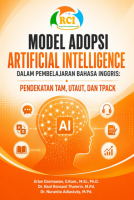
Model Adopsi Artificial Intelligence Dalam Pembelajaran Bahasa Inggris: Pendekatan Tam, Utaut, Dan Tpack
Synopsis
SPESIFIKASI BUKU
Harga : Rp 65.000
Ukuran : 14.8 cm x 21 cm
Jumlah Halaman : 119 hal
Ketebalan Buku : 1 cm
ISBN : On Proses
Deskripsi Buku : Buku ini disusun sebagai bagian dari upaya untuk memberikan pemahaman yang komprehensif mengenai perkembangan Artificial Intelligence (AI) serta berbagai faktor yang memengaruhi penerimaan, penggunaan, dan integrasinya dalam pembelajaran bahasa Inggris. Perkembangan teknologi digital, khususnya Artificial Intelligence, telah membawa perubahan yang signifikan dalam dunia pendidikan. Kehadiran berbagai teknologi berbasis AI, seperti chatbot, intelligent tutoring system, adaptive learning system, natural language processing, learning analytics, dan generative artificial intelligence, telah membuka peluang baru dalam penyelenggaraan pembelajaran. Dalam pendidikan bahasa Inggris, AI dapat dimanfaatkan untuk mendukung pengembangan keterampilan menyimak, berbicara, membaca, dan menulis, sekaligus membantu guru dalam merancang materi, mengembangkan evaluasi, memberikan umpan balik, dan menciptakan pengalaman belajar yang lebih personal dan adaptif.
REFERENSI :
Braun, V., & Clarke, V. (2006). Using thematic analysis in psychology. Qualitative Research in Psychology, 3(2), 77–101. https://doi.org/10.1191/1478088706qp063oa
Compeau, D. R., & Higgins, C. A. (1995). Computer self-efficacy: Development of a measure and initial test. MIS Quarterly, 19(2), 189–211. https://doi.org/10.2307/249688
Creswell, J. W., & Plano Clark, V. L. (2018). Designing and conducting mixed methods research (3rd ed.). SAGE Publications.
Darmawan, E., Abdul Rahman, T. K., & Thamrin, N. R. (2024). Evaluating readiness and acceptance of artificial intelligence adoption among elementary school teachers. Jurnal Online Informatika, 9(2), 228–237. https://doi.org/10.15575/join.v9i2.1385
Darmawan, E., Thamrin, N. R., & Adiastuty, N. (2027). Artificial intelligence in English language teaching: Exploring adoption and pedagogical impact in senior high schools. Jurnal Online Informatika, 12(1).
Davis, F. D. (1989). Perceived usefulness, perceived ease of use, and user acceptance of information technology. MIS Quarterly, 13(3), 319–340. https://doi.org/10.2307/249008
Hevner, A. R., March, S. T., Park, J., & Ram, S. (2004). Design science in information systems research. MIS Quarterly, 28(1), 75–105. https://doi.org/10.2307/25148625
Holmes, W., Bialik, M., & Fadel, C. (2022). Artificial intelligence in education: Promises and implications for teaching and learning (2nd ed.). Center for Curriculum Redesign.
Kasneci, E., Sessler, K., Küchemann, S., Bannert, M., Dementieva, D., Fischer, F., Gasser, U., Groh, G., Günnemann, S., Hüllermeier, E., Krusche, S., Kutyniok, G., Michaeli, T., Nerdel, C., Pfeiffer, F., Poquet, O., Sailer, M., Schmidt, A., Seidel, T., … Kasneci, G. (2023). ChatGPT for good? On opportunities and challenges of large language models for education. Learning and Individual Differences, 103, Article 102274. https://doi.org/10.1016/j.lindif.2023.102274
Koehler, M. J., Mishra, P., Kereluik, K., Shin, T. S., & Graham, C. R. (2013). The technological pedagogical content knowledge framework. In J. M. Spector, M. D. Merrill, J. Elen, & M. J. Bishop (Eds.), Handbook of research on educational communications and technology (4th ed., pp. 101–111). Springer. https://doi.org/10.1007/978-1-4614-3185-5_9
Kohnke, L., Moorhouse, B. L., & Zou, D. (2023). ChatGPT for language teaching and learning. RELC Journal, 54(2), 537–550. https://doi.org/10.1177/00336882231162868
Laudon, K. C., & Laudon, J. P. (2022). Management information systems: Managing the digital firm (17th ed.). Pearson.
Luckin, R., Holmes, W., Griffiths, M., & Forcier, L. B. (2016). Intelligence unleashed: An argument for AI in education. Pearson.
Mishra, P., & Koehler, M. J. (2006). Technological pedagogical content knowledge: A framework for teacher knowledge. Teachers College Record, 108(6), 1017–1054. https://doi.org/10.1111/j.1467-9620.2006.00684.x
Ng, W. (2012). Can we teach digital natives digital literacy? Computers & Education, 59(3), 1065–1078. https://doi.org/10.1016/j.compedu.2012.04.016
Russell, S., & Norvig, P. (2021). Artificial intelligence: A modern approach (4th ed.). Pearson.
Siemens, G., & Baker, R. S. (2012). Learning analytics and educational data mining: Towards communication and collaboration. In Proceedings of the 2nd International Conference on Learning Analytics and Knowledge (pp. 252–254). Association for Computing Machinery. https://doi.org/10.1145/2330601.2330661
Tlili, A., Shehata, B., Adarkwah, M. A., Bozkurt, A., Hickey, D. T., Huang, R., & Agyemang, B. (2023). What if the devil is my guardian angel: ChatGPT as a case study of using chatbots in education. Smart Learning Environments, 10(1), 15. https://doi.org/10.1186/s40561-023-00237-x
Trust, T., Whalen, J., & Mouza, C. (2023). Educators' perceptions of the role of AI in teaching and learning. Computers and Education: Artificial Intelligence, 4, Article 100131. https://doi.org/10.1016/j.caeai.2023.100131
UNESCO. (2023). Guidance for generative AI in education and research. UNESCO. https://unesdoc.unesco.org
Venkatesh, V., Morris, M. G., Davis, G. B., & Davis, F. D. (2003). User acceptance of information technology: Toward a unified view. MIS Quarterly, 27(3), 425–478. https://doi.org/10.2307/30036540
Yang, X., Li, Y., Wang, Q., & Chen, H. (2023). Artificial intelligence in English language education: A systematic review of applications and challenges. Education and Information Technologies, 28(11), 14567–14592. https://doi.org/10.1007/s10639-023-11744-2
Zawacki-Richter, O., Marín, V. I., Bond, M., & Gouverneur, F. (2019). Systematic review of research on artificial intelligence applications in higher education: Where are the educators? International Journal of Educational Technology in Higher Education, 16(1), 39. https://doi.org/10.1186/s41239-019-0171-0