
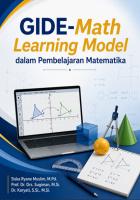
GIDE-Math Learning Model dalam Pembelajaran Matematika
Synopsis
SPESIFIKASI BUKU
Harga : Rp 95.000
Ukuran : 18 cm x 25 cm
Jumlah Halaman : 105 hal
Ketebalan Buku : 1 cm
ISBN : On Proses
Deskripsi Buku :
Buku model pembelajaran ini dikembangkan dengan mengambil materi atau pokok bahasan “Transformasi”. Buku model pembelajaran ini dikembangkan sesuai dengan isi mata pelajaran matematika SMP kelas IX pada Kurikulum Merdeka. Sintak atau langkah-langkah pembelajaran dalam GIDE-Math Learning Model meliputi: Problem Engagement, Guided Mathematical Exploration, Analytical Reasoning and Conjecturing, Verification, Generalization, dan Reflective Conclusion.
REFERENSI :
Abdur Rahman, A. (2014). Mewujudkan pendekatan saintifik dalam kelas matematika. Conference Paper, 1–21. https://doi.org/10.13140/2.1.5059.2808
Alexandra, G., & Ratu, N. (2018). Profile of mathematical critical thinking skills of junior high school students with graded response models. Jurnal Pendidikan Matematika, 7(1), 103–112. https://doi.org/10.31980/mosharafa.v7i1.480
Broadbent, J., & Poon, W. L. (2015). Self-regulated learning strategies and academic achievement in online higher education learning environments: A systematic review. Internet and Higher Education, 27, 1–13. https://doi.org/10.1016/j.iheduc.2015.04.007
Bülbül, B. Ö., & Güler, M. (2023). Examining the effect of dynamic geometry software on supporting geometric habits of mind: A qualitative inquiry. E-Learning and Digital Media, 20(2), 138–161. https://doi.org/10.1177/20427530221107776
Chew, C. M., & Lim, C. S. (2013). Enhancing primary pupils’ geometric thinking through phase-based instruction using The Geometer’s Sketchpad. Asia Pacific Journal of Educators and Education, 28, 33–51. https://fileserver-az.core.ac.uk/download/pdf/83543589.pdf
Dent, A. L., & Koenka, A. C. (2016). The relation between self-regulated learning and academic achievement across childhood and adolescence: A meta-analysis. Educational Psychology Review, 28(3), 425–474. https://doi.org/10.1007/s10648-015-9320-8
Dinsmore, D. L., Alexander, P. A., & Loughlin, S. M. (2008). Focusing the conceptual lens on metacognition, self-regulation, and self-regulated learning. Educational Psychology Review, 20(4), 391–409. https://doi.org/10.1007/s10648-008-9083-6
Fauzi, A., & Widjajanti, D. B. (2018). Self-regulated learning: The effect on student’s mathematics achievement. Journal of Physics: Conference Series, 1097(1), Article 012139. https://doi.org/10.1088/1742-6596/1097/1/012139
Fisher, A. (2001). *Critical thinking: An introduction* (2nd ed.). Press Syndicate of the University of Cambridge. https://doi.org/10.22329/il.v22i2.2583
Hafiz, M., Darhim, & Dahlan, J. A. (2020). Comparison of mathematical literacy enhancement between students with problem-based learning and guided discovery learning model. Journal of Physics: Conference Series, 1521(3), Article 032075. https://doi.org/10.1088/1742-6596/1521/3/032075
Hillmayr, D., Ziernwald, L., Reinhold, F., Hofer, S. I., & Reiss, K. M. (2020). The potential of digital tools to enhance mathematics and science learning in secondary schools: A context-specific meta-analysis. Computers and Education, 153, 103897. https://doi.org/10.1016/j.compedu.2020.103897
Hodiyanto, & Santoso, D. (2019). Geometer’s Sketchpad (GSP) dan pemahaman konsep geometri analitik bidang. Jurnal Matematika Kreatif Inovatif, 10(2), 153–158. http://journal.unnes.ac.id/nju/index.php/kreano
İBİLİ, E. (2019). The use of dynamic geometry software from a pedagogical perspective: Current status and future prospects. Journal of Computer and Education Research, 7(14), 337–355. https://doi.org/10.18009/jcer.579517
Ibrahim, I., & Afifah, R. Y. (2012). Pengaruh pembelajaran guided discovery terhadap peningkatan kemampuan penalaran matematis dan self-regulated learning siswa. Jurnal Pendidikan MIPA, 13(2), 125–134. https://doi.org/10.23960/jpmipa/v13i2.pp125-134
Isrok’atun, & Rosmala, A. (2018). *Model-model pembelajaran matematika*. PT Bumi Aksara.
Joyce, B. R., & Calhoun, E. (2025). *Models of teaching* (10th ed., pp. 1–71). Routledge. https://doi.org/10.4324/9781003455370
Kizilcec, R. F., Pérez-Sanagustín, M., & Maldonado, J. J. (2017). Self-regulated learning strategies predict learner behavior and goal attainment in massive open online courses. Computers and Education, 104, 18–33. https://doi.org/10.1016/j.compedu.2016.10.001
Lazonder, A. W., & Harmsen, R. (2016). Meta-analysis of inquiry-based learning: Effects of guidance. Review of Educational Research, 86(3), 681–718. https://doi.org/10.3102/0034654315627366
Muntari, M., Muti’ah, M., Idrus, S. W. Al, & Supriadi, S. (2021). Pendampingan implementasi pembelajaran guided discovery melalui lesson study for learning community (LSLC) untuk peningkatan kemampuan berpikir kritis kimia siswa SMA Zonasi Narmada Kabupaten Lombok Barat. Jurnal Pengabdian Magister Pendidikan IPA, 4(1). https://doi.org/10.29303/jpmpi.v4i1.603
Olusegun, S. (2015). Constructivism learning theory: A paradigm for teaching and learning. IOSR Journal of Research & Method in Education, 5(6), 66–70. https://doi.org/10.9790/7388-05616670
Panadero, E. (2017). A review of self-regulated learning: Six models and four directions for research. Frontiers in Psychology, 8, 1–28. https://doi.org/10.3389/fpsyg.2017.00422
Purwanto, C. E., Nugroho, S. E., & Wiyanto. (2012). Penerapan model pembelajaran guided discovery pada materi pemantulan cahaya untuk meningkatkan berpikir kritis. Unnes Physics Education Journal, 1(1), 26–32. https://doi.org/10.15294/upej.v1i1.768
Rahmawati, F. A., & Purwaningrum, J. P. (2022). Penerapan teori Vygotsky dalam pembelajaran matematika. Jurnal Riset Pembelajaran Matematika, 4(1), 1–4. https://doi.org/10.55719/jrpm.v4i1.349
Sachdeva, S., & Eggen, P.-O. (2021). Learners’ critical thinking about learning mathematics. International Electronic Journal of Mathematics Education, 16(3), Article em0644. https://doi.org/10.29333/iejme/11003
Simbolon, E. R., & Tapilouw, F. S. (2015). Pengaruh pembelajaran berbasis masalah dan pembelajaran kontekstual terhadap berpikir kritis siswa SMP. Edusains, 7(1), 97–104. https://doi.org/10.15408/es.v7i1.1533
Wayudi, M., S., S., & Santoso, B. (2020). Tingkat kemampuan berpikir kritis siswa berdasarkan self-regulated learning melalui metode guided discovery learning. Edueksos: Jurnal Pendidikan Sosial & Ekonomi, 9(2), 18–35. https://doi.org/10.24235/edueksos.v9i2.6329
Zhou, J. (2020). A critical discussion of Vygotsky and Bruner’s theory and their contribution to understanding of the way students learn. Review of Educational Theory, 3(4), 82. https://doi.org/10.30564/ret.v3i4.2444
Zimmerman, B. J. (1990). Self-regulated learning and academic achievement: An overview. Educational Psychologist, 25(1), 3–17. https://doi.org/10.1207/s15326985ep2501_2
Published
July 31, 2026
Copyright (c) 2026 Perkumpulan Rumah Cemerlang Indonesia
Details about the available publication format: Pratinjau Buku
Pratinjau Buku
Physical Dimensions
Details about the available publication format: Beli Buku
Beli Buku


