
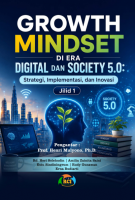
Growth Mindset Di Era Digital Dan Society 5.0: Strategi, Implementasi, dan Inovasi Jilid 1
Synopsis
SPESIFIKASI BUKU
Harga : Rp 185.000
Ukuran : 15 x 23 cm
Jumlah Halaman : 318 hal
Ketebalan Buku : 1 cm
ISBN : 978-634-239-522-6
Deskripsi Buku : Puji syukur ke hadirat Allah Swt. atas segala limpahan rahmat, taufik, dan hidayah-Nya sehingga buku berjudul Growth Mindset di Era Digital dan Society 5.0: Strategi, Implementasi, dan Inovasi (Jilid 1) ini dapat diselesaikan dengan baik. Shalawat dan salam semoga senantiasa tercurah kepada Nabi Muhammad Saw. yang telah membawa umat manusia menuju peradaban yang penuh ilmu pengetahuan, akhlak mulia, dan semangat untuk terus belajar sepanjang hayat. Perkembangan teknologi digital yang begitu pesat telah membawa perubahan besar dalam berbagai aspek kehidupan. Era Society 5.0 menghadirkan tantangan sekaligus peluang bagi setiap individu untuk mampu beradaptasi, berpikir kreatif, berinovasi, serta memiliki ketahanan mental dalam menghadapi perubahan yang dinamis. Dalam konteks tersebut, growth mindset menjadi salah satu fondasi utama yang perlu dimiliki agar setiap individu mampu melihat tantangan sebagai kesempatan untuk berkembang, menjadikan kegagalan sebagai proses pembelajaran, serta terus meningkatkan kompetensi diri secara berkelanjutan.
REFERENSI :
Adger, W. N. (2000). Social and ecological resilience: Are they related? Progress in Human Geography, 24(3), 347–364.
Al-Ghazali. (2011). Ihya ulumuddin. Republika.
Arikunto, S. (2018). Dasar-dasar evaluasi pendidikan. Bumi Aksara.
Ausubel, D. P. (1968). Educational psychology: A cognitive view. Holt, Rinehart and Winston.
Bandura, A. (1997). Self-efficacy: The exercise of control. W. H. Freeman.
Bass, B. M., & Riggio, R. E. (2006). Transformational leadership (2nd ed.). Lawrence Erlbaum Associates.
Bass, B. M., & Riggio, R. E. (2006). Transformational leadership. Psychology Press.
Bauman, Z. (2007). Liquid times: Living in an age of uncertainty. Polity Press.
Baumeister, R. F., & Tierney, J. (2011). Willpower: Rediscovering the greatest human strength. Penguin Press.
Bawden, D. (2008). Origins and concepts of digital literacy. In C. Lankshear & M. Knobel (Eds.), Digital literacies: Concepts, policies and practices. Peter Lang.
Biggs, J., & Tang, C. (2011). Teaching for quality learning at university (4th ed.). Open University Press.
Black, P., & Wiliam, D. (1998). Assessment and classroom learning. Assessment in Education, 5(1), 7–74.
Bloom, B. S. (1956). Taxonomy of educational objectives. Longmans.
Buckingham, D. (2007). Media education: Literacy, learning and contemporary culture. Polity Press.
Burns, J. M. (1978). Leadership. Harper & Row.
Castells, M. (2010). The rise of the network society. Wiley-Blackwell.
Chambers, R. (1995). Poverty and livelihoods: Whose reality counts? Institute of Development Studies.
Chambers, R. (1997). Whose reality counts? Putting the first last. Intermediate Technology Publications.
Chambers, R. (2014). Rural development: Putting the last first. Routledge.
Christensen, C. M. (1997). The innovator’s dilemma: When new technologies cause great firms to fail. Harvard Business School Press.
Coser, L. A. (1956). The functions of social conflict. Free Press.
Covey, S. R. (2004). The 7 habits of highly effective people. Free Press.
Creswell, J. W. (2018). Research design: Qualitative, quantitative, and mixed methods approaches (5th ed.). Sage Publications.
Dahrendorf, R. (1959). Class and class conflict in industrial society. Stanford University Press.
Dees, J. G. (1998). The meaning of social entrepreneurship. Stanford University.
Dees, J. G. (2001). The meaning of social entrepreneurship. Stanford University.
Delors, J. (1996). Learning: The treasure within. UNESCO Publishing.
Dessler, G. (2020). Human resource management (16th ed.). Pearson.
DeVito, J. A. (2016). The interpersonal communication book (14th ed.). Pearson.
Dewey, J. (1933). How we think. D.C. Heath.
Drucker, P. F. (1985). Innovation and entrepreneurship. Harper & Row.
Drucker, P. F. (1993). Post-capitalist society. Harper Business.
Drucker, P. F. (2007). Innovation and entrepreneurship. Routledge.
Duckworth, A. (2016). Grit: The power of passion and perseverance. Scribner.
Durkheim, E. (1997). The division of labor in society. Free Press.
Dweck, C. S. (2016). Mindset: The new psychology of success. Random House.
Etzkowitz, H., & Leydesdorff, L. (2000). The dynamics of innovation: From national systems and Mode 2 to a triple helix of university-industry-government relations. Research Policy, 29(2), 109–123.
Fisher, R., Ury, W., & Patton, B. (2000). Getting to yes: Negotiating agreement without giving in. Penguin Books.
Florida, R. (2014). The rise of the creative class. Basic Books.
Floridi, L. (2013). The ethics of information. Oxford University Press.
Freire, P. (2005). Pedagogy of the oppressed (30th anniversary ed.). Continuum.
Fukuyama, M. (2018). Society 5.0: Aiming for a new human-centered society. Japan Spotlight, 27(5), 47–50.
Fullan, M. (2001). Leading in a culture of change. Jossey-Bass.
Fullan, M., Quinn, J., & McEachen, J. (2018). Deep learning: Engage the world, change the world. Corwin Press.
Giddens, A. (2009). Sociology (6th ed.). Polity Press.
Gilster, P. (1997). Digital literacy. Wiley Computer Publishing.
Goleman, D. (1995). Emotional intelligence. Bantam Books.
Goleman, D. (2015). Emotional intelligence. Bantam Books.
Gross, J. J. (2014). Handbook of emotion regulation (2nd ed.). Guilford Press.
Grotberg, E. H. (1995). A guide to promoting resilience in children. Bernard Van Leer Foundation.
Guilford, J. P. (1967). The nature of human intelligence. McGraw-Hill.
Hattie, J. (2009). Visible learning. Routledge.
Hattie, J. (2009). Visible learning: A synthesis of over 800 meta-analyses relating to achievement. Routledge.
References
Adger, W. N. (2000). Social and ecological resilience: Are they related? Progress in Human Geography, 24(3), 347–364.
Al-Ghazali. (2011). Ihya ulumuddin. Republika.
Arikunto, S. (2018). Dasar-dasar evaluasi pendidikan. Bumi Aksara.
Ausubel, D. P. (1968). Educational psychology: A cognitive view. Holt, Rinehart and Winston.
Bandura, A. (1997). Self-efficacy: The exercise of control. W. H. Freeman.
Bass, B. M., & Riggio, R. E. (2006). Transformational leadership (2nd ed.). Lawrence Erlbaum Associates.
Bass, B. M., & Riggio, R. E. (2006). Transformational leadership. Psychology Press.
Bauman, Z. (2007). Liquid times: Living in an age of uncertainty. Polity Press.
Baumeister, R. F., & Tierney, J. (2011). Willpower: Rediscovering the greatest human strength. Penguin Press.
Bawden, D. (2008). Origins and concepts of digital literacy. In C. Lankshear & M. Knobel (Eds.), Digital literacies: Concepts, policies and practices. Peter Lang.
Biggs, J., & Tang, C. (2011). Teaching for quality learning at university (4th ed.). Open University Press.
Black, P., & Wiliam, D. (1998). Assessment and classroom learning. Assessment in Education, 5(1), 7–74.
Bloom, B. S. (1956). Taxonomy of educational objectives. Longmans.
Buckingham, D. (2007). Media education: Literacy, learning and contemporary culture. Polity Press.
Burns, J. M. (1978). Leadership. Harper & Row.
Castells, M. (2010). The rise of the network society. Wiley-Blackwell.
Chambers, R. (1995). Poverty and livelihoods: Whose reality counts? Institute of Development Studies.
Chambers, R. (1997). Whose reality counts? Putting the first last. Intermediate Technology Publications.
Chambers, R. (2014). Rural development: Putting the last first. Routledge.
Christensen, C. M. (1997). The innovator’s dilemma: When new technologies cause great firms to fail. Harvard Business School Press.
Coser, L. A. (1956). The functions of social conflict. Free Press.
Covey, S. R. (2004). The 7 habits of highly effective people. Free Press.
Creswell, J. W. (2018). Research design: Qualitative, quantitative, and mixed methods approaches (5th ed.). Sage Publications.
Dahrendorf, R. (1959). Class and class conflict in industrial society. Stanford University Press.
Dees, J. G. (1998). The meaning of social entrepreneurship. Stanford University.
Dees, J. G. (2001). The meaning of social entrepreneurship. Stanford University.
Delors, J. (1996). Learning: The treasure within. UNESCO Publishing.
Dessler, G. (2020). Human resource management (16th ed.). Pearson.
DeVito, J. A. (2016). The interpersonal communication book (14th ed.). Pearson.
Dewey, J. (1933). How we think. D.C. Heath.
Drucker, P. F. (1985). Innovation and entrepreneurship. Harper & Row.
Drucker, P. F. (1993). Post-capitalist society. Harper Business.
Drucker, P. F. (2007). Innovation and entrepreneurship. Routledge.
Duckworth, A. (2016). Grit: The power of passion and perseverance. Scribner.
Durkheim, E. (1997). The division of labor in society. Free Press.
Dweck, C. S. (2016). Mindset: The new psychology of success. Random House.
Etzkowitz, H., & Leydesdorff, L. (2000). The dynamics of innovation: From national systems and mode 2 to a triple helix of university-industry-government relations. Research Policy, 29(2), 109–123.
Fisher, R., Ury, W., & Patton, B. (2000). Getting to yes: Negotiating agreement without giving in. Penguin Books.
Florida, R. (2014). The rise of the creative class. Basic Books.
Floridi, L. (2013). The ethics of information. Oxford University Press.
Freire, P. (2005). Pedagogy of the oppressed (30th anniversary ed.). Continuum.
Fukuyama, M. (2018). Society 5.0: Aiming for a new human-centered society. Japan Spotlight, 27(5), 47–50.
Fullan, M. (2001). Leading in a culture of change. Jossey-Bass.
Fullan, M., Quinn, J., & McEachen, J. (2018). Deep learning: Engage the world change the world. Corwin Press.
Giddens, A. (2009). Sociology (6th ed.). Polity Press.
Gilster, P. (1997). Digital literacy. Wiley Computer Publishing.
Goleman, D. (1995). Emotional intelligence. Bantam Books.
Goleman, D. (2015). Emotional intelligence. Bantam Books.
Gross, J. J. (2014). Handbook of emotion regulation (2nd ed.). Guilford Press.
Grotberg, E. H. (1995). A guide to promoting resilience in children. Bernard Van Leer Foundation.
Guilford, J. P. (1967). The nature of human intelligence. McGraw-Hill.
Hattie, J. (2009). Visible learning. Routledge.
Hattie, J. (2009). Visible learning: A synthesis of over 800 meta-analyses relating to achievement. Routledge.
Howkins, J. (2001). The creative economy: How people make money from ideas. Penguin Books.
Hubbard, D. W. (2020). The failure of risk management. Wiley.
Ife, J. (2013). Community development in an uncertain world. Cambridge University Press.
Ife, J., & Tesoriero, F. (2008). Community development: Community-based alternatives in an age of globalization. Pearson Education.
Jenkins, H. (2009). Confronting the challenges of participatory culture. MIT Press.
Johnson, D. W., & Johnson, F. P. (2017). Joining together: Group theory and group skills (12th ed.). Pearson.
Johnson, D. W., & Johnson, R. T. (2014). Cooperative learning in 21st century. Anales de Psicología.
Kaplan, A. M., & Haenlein, M. (2010). Users of the world, unite! The challenges and opportunities of social media. Business Horizons, 53(1), 59–68.
Keck, M., & Sakdapolrak, P. (2013). What is social resilience? Lessons learned and ways forward. Erdkunde, 67(1), 5–19.
Keidanren. (2018). Society 5.0: Co-creating the future. Japan Business Federation.
Kirkpatrick, J. D., & Kirkpatrick, W. K. (2016). Kirkpatrick’s four levels of training evaluation. ATD Press.
Knowles, M. S. (1984). The adult learner: A neglected species. Gulf Publishing.
Knowles, M. S., Holton, E. F., & Swanson, R. A. (2015). The adult learner (8th ed.). Routledge.
Kolb, D. A. (2015). Experiential learning: Experience as the source of learning and development. Pearson Education.
Kotler, P., Kartajaya, H., & Setiawan, I. (2021). Marketing 5.0: Technology for humanity. Wiley.
Kotter, J. P. (1996). Leading change. Harvard Business School Press.
Kuratko, D. F. (2017). Entrepreneurship: Theory, process, and practice. Cengage Learning.
Laudon, K. C., & Laudon, J. P. (2020). Management information systems: Managing the digital firm (16th ed.). Pearson.
Lauster, P. (2012). Tes kepribadian. Bumi Aksara.
Ledwith, M. (2016). Community development in action: Putting Freire into practice. Policy Press.
Leithwood, K., & Jantzi, D. (2005). Transformational leadership. In B. Davies (Ed.), The essentials of school leadership (pp. 31–43). Sage Publications.
Lickona, T. (2013). Educating for character: How our schools can teach respect and responsibility. Bantam Books.
Maslow, A. H. (1970). Motivation and personality (2nd ed.). Harper & Row.
McCarthy, J. (2007). What is artificial intelligence? Stanford University Press.
McClelland, D. C. (1961). The achieving society. Princeton University Press.
Munandar, U. (2012). Pengembangan kreativitas anak berbakat. Rineka Cipta.
Munandar, U. (2014). Pengembangan kreativitas anak berbakat. Rineka Cipta.
Murphy, M. C., & Dweck, C. S. (2010). A culture of genius: How an organization’s lay theory shapes people’s cognition, affect, and behavior. Personality and Social Psychology Bulletin, 36(3), 283–296.
Negroponte, N. (1995). Being digital. Alfred A. Knopf.
Noe, R. A. (2020). Employee training and development (8th ed.). McGraw-Hill.
Northouse, P. G. (2019). Leadership: Theory and practice (8th ed.). Sage Publications.
Northouse, P. G. (2021). Leadership: Theory and practice (9th ed.). Sage Publications.
Polya, G. (1973). How to solve it. Princeton University Press.
Putnam, R. D. (2000). Bowling alone: The collapse and revival of American community. Simon & Schuster.
Reivich, K., & Shatté, A. (2002). The resilience factor. Broadway Books.
Ribble, M. (2015). Digital citizenship in schools (3rd ed.). International Society for Technology in Education.
Ries, E. (2011). The lean startup. Crown Business.
Robbins, S. P., & Coulter, M. (2018). Management (14th ed.). Pearson.
Robinson, K. (2011). Out of our minds: Learning to be creative. Capstone Publishing.
Rossi, P. H., Lipsey, M. W., & Freeman, H. E. (2019). Evaluation: A systematic approach (8th ed.). Sage Publications.
Russell, S., & Norvig, P. (2021). Artificial intelligence: A modern approach (4th ed.). Pearson.
Santrock, J. W. (2018). Educational psychology (6th ed.). McGraw-Hill Education.
Sardiman. (2018). Interaksi dan motivasi belajar mengajar. Rajawali Pers.
Schön, D. A. (1983). The reflective practitioner. Basic Books.
Schumpeter, J. A. (1934). The theory of economic development. Harvard University Press.
Schwab, K. (2016). The fourth industrial revolution. Crown Business.
Seligman, M. E. P. (2011). Flourish: A visionary new understanding of happiness and well-being. Free Press.
Senge, P. M. (2006). The fifth discipline: The art and practice of the learning organization. Doubleday.
Siemens, G. (2005). Connectivism: A learning theory for the digital age. International Journal of Instructional Technology and Distance Learning, 2(1), 3–10.
Soekanto, S. (2012). Sosiologi suatu pengantar. Rajawali Pers.
Solehudin, R. H. (2024). Analisis kebijakan interseksional dalam pelayanan masyarakat urban non-register di Jakarta. Universitas Muhammadiyah Prof. Dr. Hamka.
Solehudin, R. H. (2024). Pendampingan growth mindset parenting bagi keluarga urban produktif Kota Depok. Universitas Muhammadiyah Prof. Dr. Hamka.
Solehudin, R. H. (2025). Business intelligence dan analisis kuantitatif. Damera Press.
Solehudin, R. H. (2025). Komunikasi politik pemerintahan modern. UNU Press.
Solehudin, R. H. (2025). Masa depan pendidikan dalam era deep learning: Teori dan aplikasi. Uhamka Press.
Solehudin, R. H. (2025). The existence of Dodol Betawi in the post Covid-19 era: A case study. Universitas Muhammadiyah Prof. Dr. Hamka.
Solehudin, R. H. (2026). Pelatihan terpadu growth mindset, parenting dalam mendukung ketahanan dan kesejahteraan keluarga di Kota Depok. Direktorat Jenderal Pendidikan Tinggi Kemendikbudristek RI.
Solehudin, R. H. (2026). Pendampingan growth mindset parenting bagi keluarga urban produktif Kota Depok. Universitas Muhammadiyah Prof. Dr. Hamka.
Stufflebeam, D. L., & Shinkfield, A. J. (2007). Evaluation theory, models, and applications. Jossey-Bass.
Suryana. (2013). Kewirausahaan: Pedoman praktis, kiat dan proses menuju sukses. Salemba Empat.
Tapscott, D. (2009). Grown up digital. McGraw-Hill.
Toffler, A. (1980). The third wave. William Morrow and Company.
Tu’u, T. (2004). Peran disiplin pada perilaku dan prestasi siswa. Grasindo.
UNESCO. (2018). A global framework of reference on digital literacy skills for indicator 4.4.2. UNESCO Institute for Statistics.
Uno, H. B. (2016). Teori motivasi dan pengukurannya. Bumi Aksara.
Vygotsky, L. S. (1978). Mind in society. Harvard University Press.
Whitman, M. E., & Mattord, H. J. (2018). Principles of information security (6th ed.). Cengage Learning.
Yukl, G. (2013). Leadership in organizations (8th ed.). Pearson Education.
Zachary, L. J. (2012). The mentor’s guide: Facilitating effective learning relationships. Jossey-Bass.
Zimmerer, T. W., & Scarborough, N. M. (2008). Essentials of entrepreneurship and small business management. Pearson Education.
Published
August 10, 2026
Copyright (c) 2026 Perkumpulan Rumah Cemerlang Indonesia
Details about the available publication format: Pratinjau Buku
Pratinjau Buku
Physical Dimensions
Details about the available publication format: Beli Buku
Beli Buku


