
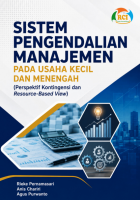
Sistem Pengendalian Manajemen Pada Usaha Kecil Dan Menengah (Perspektif Kontingensi Dan Resource-based View)
Synopsis
SPESIFIKASI BUKU
◉ Harga : Rp 65.000
◉ Ukuran : 14,8 cm x 21 cm
◉ Jumlah Halaman : 121 hal
◉ Ketebalan Buku : 1 cm
◉ ISBN : On Proses
◉ Deskripsi Buku : Usaha Kecil dan Menengah merupakan tulang punggung perekonomian nasional Indonesia. Kontribusinya yang besar terhadap jumlah unit usaha, penyerapan tenaga kerja, dan pembentukan produk domestik bruto menempatkan UKM sebagai aktor strategis dalam pembangunan ekonomi. Namun di balik angka tersebut, banyak UKM masih menghadapi tantangan serius dalam pengelolaan dan pengendalian manajemen yang efektif mulai dari keterbatasan sistem pencatatan keuangan, lemahnya pengendalian operasional, hingga minimnya mekanisme evaluasi kinerja yang terstruktur. Dalam konteks inilah Sistem Pengendalian Manajemen (SPM) menjadi instrumen yang sangat strategis. SPM tidak hanya berperan dalam menjaga stabilitas keuangan dan kelancaran operasional, tetapi juga membantu UKM mengelola sumber daya secara optimal, mengidentifikasi dan memitigasi risiko bisnis, serta meningkatkan transparansi dan akuntabilitas organisasi. Buku ini disusun sebagai buku referensi ilmiah yang menelaah SPM pada UKM dari sudut pandang Teori Kontingensi dan Resource-Based View. Sebagian besar literatur SPM selama enam dekade terakhir dikembangkan dari pengalaman perusahaan besar, sementara kajian yang secara khusus menyasar UKM baru berkembang satu dekade belakangan dan masih tersebar di berbagai jurnal tanpa sintesis yang memadai. Buku ini berupaya mengisi ruang tersebut dengan menghimpun, memetakan, dan menafsirkan perkembangan riset SPM di UKM secara sistematis.
REFERENSI :
Abba, M., Yahaya, L., & Suleiman, N. (2018). Explored and critique of contingency theory for management accounting research. Journal of Accounting and Financial Management, 4(5), 40–50.
Acquaah, M. (2013). Management control systems, business strategy and performance: A comparative analysis of family and non-family businesses in a transition economy in sub-Saharan Africa. Journal of Family Business Strategy, 4(2), 131–146. https://doi.org/10.1016/j.jfbs.2013.03.002
Akbar, T., Pratiwi, E. U., Iskandar, D., Tanjung, P. R. S., Chairunesia, W., Utami, F. L., Melzatia, S., Pernamasari, R., Hidayah, N., & Hakim Z, A. (2026). Akuntansi manajemen: Teknik dan strategi pengelolaan biaya dalam bisnis. PT Cipta Digital Edukasi.
Anthony, R. N. (1965). Planning and control systems: A framework for analysis. Division of Research, Harvard Business School.
Barney, J. (1991). Firm resources and sustained competitive advantage. Journal of Management, 17(1), 99–120. https://doi.org/10.1177/014920639101700108
Barney, J., Wright, M., & Ketchen, D. J. (2001). The resource-based view of the firm: Ten years after 1991. Journal of Management, 27(6), 625–641. https://doi.org/10.1016/S0149-2063(01)00114-3
Bisbe, J., & Otley, D. (2004). The effects of the interactive use of management control systems on product innovation. Accounting, Organizations and Society, 29(8), 709–737. https://doi.org/10.1016/j.aos.2003.10.010
Bouquin, H. (2008). Le contrôle de gestion. Presses Universitaires de France.
Bracci, E., Mouhcine, T., Rana, T., & Wickramasinghe, D. (2022). Risk management and management accounting control systems in public sector organizations: A systematic literature review. Public Money & Management, 42(6), 395–402. https://doi.org/10.1080/09540962.2021.1963071
Braumann, E. C., Grabner, I., & Posch, A. (2020). Tone from the top in risk management: A complementarity perspective on how control systems influence risk awareness. Accounting, Organizations and Society, 84, 101128. https://doi.org/10.1016/j.aos.2020.101128
Burns, T., & Stalker, G. M. (1961). The management of innovation. Tavistock Publications.
Cardoni, A., Zanin, F., Corazza, G., & Paradisi, A. (2020). Knowledge management and performance measurement systems for SMEs’ economic sustainability. Sustainability, 12(7), 2594. https://doi.org/10.3390/su12072594
Chegri, M., Rigalma, H., & Torra, M. (2021). Management control system in the context of SMEs. Modern Management Review, 26(3), 39–58. https://doi.org/10.7862/rz.2021.mmr.16
Chenhall, R. H. (2003). Management control systems design within its organizational context: Findings from contingency-based research and directions for the future. Accounting, Organizations and Society, 28(2–3), 127–168. https://doi.org/10.1016/S0361-3682(01)00027-7
Curado, C., Jesus, M., & Bontis, N. (2022). SMEs managers’ perceptions of MCS: A mixed methods approach. Journal of Small Business Strategy, 32(4), 30–47. https://doi.org/10.53703/001c.37758
Davila, A., Foster, G., & Li, M. (2009). Reasons for management control systems adoption: Insights from product development systems choice by early-stage entrepreneurial companies. Accounting, Organizations and Society, 34(3–4), 322–347. https://doi.org/10.1016/j.aos.2008.08.002
Donaldson, L. (2001). The contingency theory of organizations. SAGE Publications.
Drazin, R., & Van de Ven, A. H. (1985). Alternative forms of fit in contingency theory. Administrative Science Quarterly, 30(4), 514–539. https://doi.org/10.2307/2392695
Endenich, C., Lachmann, M., Schachel, H., & Zajkowska, J. (2023). The relationship between management control systems and innovativeness in start-ups: Evidence for product, business model, and ambidextrous innovation. Journal of Accounting & Organizational Change, 19(5), 706–734. https://doi.org/10.1108/JAOC-06-2022-0087
Ghozali, I. (2020). 25 grand theory. Yoga Pratama.
Gordon, L. A., & Miller, D. (1976). A contingency framework for the design of accounting information systems. Accounting, Organizations and Society, 1(1), 59–69. https://doi.org/10.1016/0361-3682(76)90007-6
Grant, R. M. (1996). Toward a knowledge-based theory of the firm. Strategic Management Journal, 17(S2), 109–122. https://doi.org/10.1002/smj.4250171110
Henri, J.-F. (2006). Management control systems and strategy: A resource-based perspective. Accounting, Organizations and Society, 31(6), 529–558. https://doi.org/10.1016/j.aos.2005.07.001
Ikatan Akuntan Indonesia. (2016). Standar Akuntansi Keuangan Entitas Mikro, Kecil, dan Menengah (SAK EMKM). Dewan Standar Akuntansi Keuangan Ikatan Akuntan Indonesia.
Ikatan Akuntan Indonesia. (2021). Standar Akuntansi Keuangan Entitas Privat (SAK EP). Dewan Standar Akuntansi Keuangan Ikatan Akuntan Indonesia.
Published
August 30, 2026
Copyright (c) 2026 Perkumpulan Rumah Cemerlang Indonesia
Details about the available publication format: Pratinjau Buku
Pratinjau Buku
Physical Dimensions
Details about the available publication format: Beli Buku
Beli Buku


