
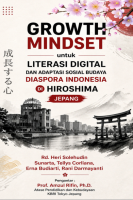
Growth Mindset Untuk Literasi Digital Dan Adaptasi Sosial Budaya Diaspora Indonesia Di Hiroshima Jepang
Synopsis
SPESIFIKASI BUKU
Harga : Rp 155.000
Ukuran : 15,5 cm x 23 cm
Jumlah Halaman : 304 hal
Ketebalan Buku : 1 cm
ISBN : On Proses
Deskripsi Buku : Perkembangan teknologi digital yang begitu pesat telah membawa perubahan besar dalam berbagai aspek kehidupan, termasuk cara manusia belajar, bekerja, berkomunikasi, dan berinteraksi lintas budaya. Bagi diaspora Indonesia yang tinggal dan beraktivitas di luar negeri, khususnya di Hiroshima, Jepang, kemampuan beradaptasi dengan lingkungan sosial budaya yang berbeda serta kecakapan dalam memanfaatkan teknologi digital menjadi kebutuhan yang sangat penting. Dalam konteks tersebut, pola pikir bertumbuh (growth mindset) menjadi fondasi yang memungkinkan individu untuk terus belajar, terbuka terhadap perubahan, dan mampu menghadapi berbagai tantangan secara positif. Buku ini hadir sebagai upaya untuk memberikan pemahaman yang komprehensif mengenai pentingnya growth mindset dalam mendukung literasi digital dan proses adaptasi sosial budaya diaspora Indonesia. Berbagai pembahasan dalam buku ini menguraikan hubungan antara pola pikir bertumbuh, kemampuan literasi digital, serta strategi adaptasi yang diperlukan dalam kehidupan masyarakat multikultural. Dengan pendekatan yang reflektif dan kontekstual, buku ini diharapkan dapat menjadi sumber inspirasi sekaligus referensi bagi mahasiswa, akademisi, praktisi pendidikan, komunitas diaspora, serta masyarakat umum yang memiliki perhatian terhadap isu transformasi digital dan dinamika kehidupan global. Hiroshima sebagai salah satu kota penting di Jepang memiliki karakter sosial dan budaya yang khas. Pengalaman diaspora Indonesia dalam berinteraksi dengan masyarakat Jepang memberikan banyak pelajaran berharga mengenai pentingnya kemampuan komunikasi, penghargaan terhadap keberagaman, serta kesiapan untuk terus belajar dalam lingkungan yang berbeda. Oleh karena itu, pengalaman dan kajian yang disajikan dalam buku ini diharapkan dapat memperkaya wawasan pembaca mengenai bagaimana membangun ketangguhan diri, memperluas jejaring sosial, dan memanfaatkan teknologi digital secara bijaksana dalam kehidupan sehari-hari.
REFERENSI :
Anderson, B. (2006). Imagined communities: Reflections on the origin and spread of nationalism (Rev. ed.). Verso.
Antonovsky, A. (1987). Unraveling the mystery of health: How people manage stress and stay well. Jossey-Bass.
Bandura, A. (1997). Self-efficacy: The exercise of control. W. H. Freeman.
Benedict, R. (1946). The chrysanthemum and the sword: Patterns of Japanese culture. Houghton Mifflin.
Bennett, M. J. (2017). Developmental model of intercultural sensitivity. Intercultural Development Research Institute.
Berry, J. W. (1997). Immigration, acculturation, and adaptation. Applied Psychology, 46(1), 5–34.
Bourdieu, P. (1986). The forms of capital. In J. Richardson (Ed.), Handbook of theory and research for the sociology of education (pp. 241–258). Greenwood.
Bronfenbrenner, U. (1979). The ecology of human development. Harvard University Press.
Cabinet Office Japan. (2019). Society 5.0. Government of Japan.
Castells, M. (2010). The rise of the network society (2nd ed.). Wiley-Blackwell.
Chambers, R. (1997). Whose reality counts? Putting the first last. Intermediate Technology Publications.
Connor, K. M., & Davidson, J. R. T. (2003). Development of a new resilience scale: The Connor-Davidson Resilience Scale (CD-RISC). Depression and Anxiety, 18(2), 76–82.
Doi, T. (1973). The anatomy of dependence. Kodansha International.
Drucker, P. F. (1985). Innovation and entrepreneurship. Harper & Row.
Dweck, C. S. (2016). Mindset: The new psychology of success. Random House.
Eshet-Alkalai, Y. (2004). Digital literacy: A conceptual framework for survival skills in the digital era. Journal of Educational Multimedia and Hypermedia, 13(1), 93–106.
Fisher, R., & Ury, W. (2011). Getting to yes: Negotiating agreement without giving in (3rd ed.). Penguin Books.
Freire, P. (1970). Pedagogy of the oppressed. Continuum.
Garrison, D. R., & Vaughan, N. D. (2008). Blended learning in higher education: Framework, principles, and guidelines. Jossey-Bass.
Gilster, P. (1997). Digital literacy. Wiley.
Gross, J. J. (2015). Emotion regulation: Current status and future prospects. Psychological Inquiry, 26(1), 1–26.
Hall, E. T. (1976). Beyond culture. Anchor Books.
Heifetz, R., Grashow, A., & Linsky, M. (2009). The practice of adaptive leadership. Harvard Business Press.
Hofstede, G. (2011). Cultures and organizations: Software of the mind (3rd ed.). McGraw-Hill.
Kaplan, A., & Haenlein, M. (2019). Siri, Siri, in my hand: Who’s the fairest in the land? On the interpretations, illustrations, and implications of artificial intelligence. Business Horizons, 62(1), 15–25.
Kindaichi, H. (1988). The Japanese language. Tuttle Publishing.
Kirkpatrick, J. D., & Kirkpatrick, W. K. (2016). Kirkpatrick’s four levels of training evaluation. ATD Press.
Knowles, M. S., Holton, E. F., & Swanson, R. A. (2020). The adult learner (9th ed.). Routledge.
Kolb, D. A. (1984). Experiential learning: Experience as the source of learning and development. Prentice Hall.
Kolb, D. A. (2015). Experiential learning: Experience as the source of learning and development (2nd ed.). Pearson Education.
Kotler, P., & Keller, K. L. (2016). Marketing management (15th ed.). Pearson.
Kotler, P., Kartajaya, H., & Setiawan, I. (2019). Marketing 4.0: Moving from traditional to digital. Wiley.
Locke, E. A., & Latham, G. P. (2002). Building a practically useful theory of goal setting and task motivation. American Psychologist, 57(9), 705–717.
Masten, A. S. (2014). Ordinary magic: Resilience in development. Guilford Press.
Matsumoto, Y. (2002). Gender identity and linguistic interaction in Japanese. Oxford University Press.
Moore, M. G. (2013). Handbook of distance education (3rd ed.). Routledge.
National Institute of Standards and Technology. (2023). Digital identity guidelines. U.S. Department of Commerce.
Nye, J. S. (2004). Soft power: The means to success in world politics. PublicAffairs.
Oberg, K. (1960). Cultural shock: Adjustment to new cultural environments. Practical Anthropology, 7(4), 177–182.
OECD. (2021). Digital security and digital transformation. OECD Publishing.
OECD. (2023). OECD digital economy outlook 2023. OECD Publishing.
Osterwalder, A., & Pigneur, Y. (2010). Business model generation. Wiley.
Ostrom, E. (1990). Governing the commons: The evolution of institutions for collective action. Cambridge University Press.
Ouchi, W. G. (1981). Theory Z: How American business can meet the Japanese challenge. Addison-Wesley.
Phillips, J. J. (2003). Return on investment in training and performance improvement programs (2nd ed.). Butterworth-Heinemann.
Putnam, R. D. (2000). Bowling alone: The collapse and revival of American community. Simon & Schuster.
Reivich, K., & Shatté, A. (2002). The resilience factor. Broadway Books.
Ribble, M. (2015). Digital citizenship in schools (3rd ed.). International Society for Technology in Education.
Ries, E. (2011). The lean startup. Crown Business.
Russell, S., & Norvig, P. (2021). Artificial intelligence: A modern approach (4th ed.). Pearson.
Published
August 31, 2026
Copyright (c) 2026 Perkumpulan Rumah Cemerlang Indonesia
Details about the available publication format: Pratinjau Buku
Pratinjau Buku
Physical Dimensions
Details about the available publication format: Beli Buku
Beli Buku


