
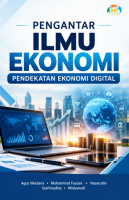
Pengantar Ilmu Ekonomi Pendekatan Ekonomi Digital
Synopsis
SPESIFIKASI BUKU
Harga : Rp 105.000
Ukuran : 15,5 cm x 23 cm
Jumlah Halaman : 183 hal
Ketebalan Buku : 1 cm
ISBN : On Proses
Deskripsi Buku : Buku ini disusun sebagai salah satu sumber belajar yang diharapkan dapat membantu mahasiswa, dosen, praktisi, serta masyarakat umum dalam memahami konsepkonsep dasar ilmu ekonomi yang terus berkembang seiring dengan kemajuan teknologi digital. Ilmu ekonomi merupakan ilmu yang mempelajari bagaimana individu, rumah tangga, perusahaan, dan pemerintah mengambil keputusan dalam mengelola sumber daya yang terbatas untuk memenuhi kebutuhan yang tidak terbatas. Dalam perkembangannya, transformasi digital telah membawa perubahan yang signifikan pada berbagai aktivitas ekonomi, mulai dari produksi, distribusi, konsumsi, hingga sistem pembayaran dan transaksi bisnis. Oleh karena itu, pemahaman terhadap ilmu ekonomi tidak lagi cukup hanya melalui pendekatan konvensional, tetapi juga perlu dilengkapi dengan perspektif ekonomi digital yang semakin relevan dalam kehidupan modern. Buku ini membahas berbagai konsep dasar ekonomi, seperti kebutuhan dan kelangkaan, mekanisme pasar, perilaku konsumen dan produsen, struktur pasar, pendapatan nasional, kebijakan fiskal dan moneter, hingga perkembangan ekonomi digital yang meliputi perdagangan elektronik (e-commerce), teknologi finansial (financial technology), ekonomi berbasis platform, transformasi digital dalam dunia usaha, serta tantangan | ii dan peluang ekonomi di era Revolusi Industri 4.0 dan Society 5.0. Penyajian materi dilakukan secara sistematis dengan bahasa yang sederhana agar mudah dipahami oleh pembaca dari berbagai latar belakang. Pendekatan ekonomi digital yang digunakan dalam buku ini bertujuan untuk memberikan wawasan yang lebih kontekstual mengenai perubahan perilaku ekonomi masyarakat saat ini. Kehadiran internet, kecerdasan buatan (Artificial Intelligence), big data, komputasi awan, dan berbagai inovasi teknologi lainnya telah menciptakan model bisnis baru yang memengaruhi cara manusia bekerja, bertransaksi, dan mengambil keputusan ekonomi. Oleh karena itu, pembaca diharapkan tidak hanya memahami teori-teori ekonomi dasar, tetapi juga mampu melihat penerapannya dalam lingkungan digital yang terus berkembang.
REFERENSI :
Acemoglu, D. (1998). Why do new technologies complement skills? Directed technical change and wage inequality. The Quarterly Journal of Economics, 113(4), 1055–1089.
Acemoglu, D. (2011). Thoughts on inequality and the financial crisis [Presentation]. American Economic Association Annual Meeting, January 7.
Aghion, P., Caroli, E., & García-Peñalosa, C. (1999). Inequality and economic growth: The perspective of the new growth theories. Journal of Economic Literature, 37(4), 1615–1660.
Alvaredo, F., Atkinson, A. B., Piketty, T., & Saez, E. (2013). The top 1 percent in international and historical perspective (NBER Working Paper No. 19075). National Bureau of Economic Research.
Atkinson, A. B., Piketty, T., & Saez, E. (2011). Top incomes in the long run of history. Journal of Economic Literature, 49(1), 3–71.
Autor, D. H. (2014). Skills, education, and the rise of earnings inequality among the “other 99 percent.” Science, 344(6186), 843–851.
Autor, D. H., Katz, L. F., & Kearney, M. S. (2006). The polarization of the U.S. labor market. American Economic Review, 96(2), 189–194.
Autor, D. H., Kerr, W. R., & Kugler, A. D. (2007). Does employment protection reduce productivity? Evidence from U.S. states. The Economic Journal, 117(June), F189–F217.
Bardhan, P. K. (2005). Scarcity, conflicts, and cooperation: Essays in the political and institutional economics of development. MIT Press.
Barro, R. J. (2000). Inequality and growth in a panel of countries. Journal of Economic Growth, 5(1), 5–32.
Bastagli, F., Coady, D., & Gupta, S. (2012). Income inequality and fiscal policy (IMF Staff Discussion Note No. 12/08). International Monetary Fund.
Becker, G. S., & Chiswick, B. R. (1966). Education and the distribution of earnings. American Economic Review, 56(1/2), 358–369.
Behar, A. (2013). The endogenous skill bias of technical change and inequality in developing countries (IMF Working Paper No. 13/50). International Monetary Fund.
Berg, A., & Ostry, J. D. (2011). Inequality and unsustainable growth: Two sides of the same coin? (IMF Staff Discussion Note No. 11/08). International Monetary Fund.
Bernanke, B. S. (2011). Global imbalances: Links to economic and financial stability [Speech]. Banque de France Financial Stability Review Launch Event, Paris, France, February 18.
Bird, A., & Mendenhall, M. E. (2015). From cross-cultural management to global leadership: Evolution and adaptation. Journal of World Business, 50, 770–778.
Bourguignon, F. (2003). The growth elasticity of poverty reduction: Explaining heterogeneity across countries and time periods. In Inequality and growth: Theory and policy implications. MIT Press.
Bourguignon, F., & Dessus, S. (2009). Equity and development: Political economy considerations. In S. Levy & M. Walton (Eds.), No growth without equity? Inequality, interests, and competition in Mexico. World Bank/Palgrave Macmillan.
Brightman, C. (2014). The profits bubble. Research Affiliates.
Bruckner, M., Dabla-Norris, E., & Gradstein, M. (n.d.). National income and its distribution. Journal of Economic Growth. [Forthcoming].
Calderón, C., & Chong, A. (2009). Labor market institutions and income inequality: An empirical exploration. Public Choice, 138(1), 65–81.
Caliguri, P., & DiSanto, V. (2001). Global competence: What is it and can it be developed through global assignments? Human Resource Planning, 24, 27–35.
Card, D., & DiNardo, J. E. (2002). Skill-biased technological change and rising wage inequality: Some problems and puzzles (NBER Working Paper No. 8769). National Bureau of Economic Research.
Carvalho, L., & Rezai, A. (2014). Personal income inequality and aggregate demand (Working Paper No. 2014-23). Department of Economics, University of São Paulo.
Castello-Climent, A., & Domenech, R. (2014). Capital and income inequality: Some facts and some puzzles (Working Paper No. 1228). Economic Research Department, BBVA Bank.
Chin, C. O., Gu, J., & Tubbs, S. L. (2001). Developing global leadership competencies. The Journal of Leadership Studies, 7(4), 20–31. https://doi.org/10.1177/107179190100700402
Cingano, F. (2014). Trends in income inequality and its impact on economic growth (OECD Social, Employment and Migration Working Papers No. 163). OECD Publishing.
Claessens, S., & Perotti, E. (2007). Finance and inequality: Channels and evidence. Journal of Comparative Economics, 35(4), 748–773.
Cohen, S. L. (2010). Effective global leadership requires a global mindset. Industrial and Commercial Training, 42(1), 3–10. https://doi.org/10.1108/00197851011013652
Congressional Budget Office. (2011). Trends in the distribution of household income between 1979 and 2007. https://www.cbo.gov/sites/default/files/10-25-HouseholdIncome_0.pdf
Corak, M. (2013). Income inequality, equality of opportunity, and intergenerational mobility. Journal of Economic Perspectives, 27(3), 79–102.
Credit Suisse. (2013). Global wealth report. Credit Suisse AG.
Dabla-Norris, E., Ho, G., Kochhar, K., Kyobe, A., & Tchaidze, R. (2013). Anchoring growth: The importance of productivity-enhancing reforms in emerging market and developing economies (IMF Staff Discussion Note No. 13/08). International Monetary Fund.
Dabla-Norris, E., & Gradstein, M. (2004). The distributional bias of public education: Causes and consequences (IMF Working Paper No. 04/214). International Monetary Fund.
Dabla-Norris, E., Inchauste, G. (2008). Informality and regulations: What drives the growth of firms? IMF Staff Papers, 55(1), 50–82.
Dabla-Norris, E., Ji, Y., Townsend, R. M., & Filiz Unsal, D. (2015). Distinguishing constraints of financial inclusion and their impact on GDP and inequality (NBER Working Paper No. 20821). National Bureau of Economic Research.
Davies, J. B., Sandström, S., Shorrocks, A., & Wolff, E. N. (2008). The world distribution of household wealth (Discussion Paper No. 2008/03). UNU-WIDER.
Duclos, J., Esteban, J., & Ray, D. (2004). Polarization: Concepts, measurement, estimation. Econometrica, 72(6), 1737–1772.
Evans, P., Pucik, V., & Barsoux, J.-L. (2002). The global challenge: Frameworks for international human resource management. McGraw-Hill.
Federal Reserve. (2014). 2013 survey of consumer finances. https://www.federalreserve.gov/econresdata/scf/scfindex.htm
Feenstra, R. C., & Hanson, G. H. (1996). Globalization, outsourcing, and wage inequality. American Economic Review, 86(2), 240–245.
Feenstra, R. C., & Hanson, G. H. (1999). The impact of outsourcing and high-technology capital on wages: Estimates for the United States, 1979–1990. The Quarterly Journal of Economics, 114(3), 907–940.
Feenstra, R. C., & Hanson, G. H. (2003). Global production sharing and rising inequality: A survey of trade and wage. In E. K. Choi & J. Harrigan (Eds.), Handbook of international trade. Blackwell.
Figini, P., & Görg, H. (2011). Does foreign direct investment affect wage inequality? An empirical investigation. The World Economy, 34(9), 1455–1475.
Fosu, A. K. (2010). Growth, inequality and poverty reduction in developing countries: Recent global evidence [OECD background paper]. Organisation for Economic Co-operation and Development.
Frederiksen, A., & Poulsen, O. (2010). Increasing income inequality: Productivity, bargaining and skill-upgrading (IZA Discussion Paper No. 4791). Institute for the Study of Labor.
Freeman, R. (2010). Does inequality increase economic output? In Controversies about inequality. Stanford University Press.
Fuentes-Nieva, R., & Galasso, N. (2014). Working for the few: Political capture and economic inequality. Oxfam International.
Furceri, D., & Loungani, P. (2013). Who let the Gini out? Finance & Development, 50(4), 25–27.
Galor, O., & Moav, O. (2004). From physical to human capital accumulation: Inequality and the process of development. The Review of Economic Studies, 71(4), 1001–1026.
Genty, K. I. (2014). Leadership styles and their implications for prosperous industrial relations in Nigeria. European Scientific Journal, 1(1), 560–574.
Genty, K. I., & Shabi, O. R. (2017). Business competencies and entrepreneurs’ success: Empirical evidence from Nigeria. Proceedings of the First Faculty of Management Sciences Conference.
Published
September 20, 2026
Copyright (c) 2026 Perkumpulan Rumah Cemerlang Indonesia
Details about the available publication format: Pratinjau Buku
Pratinjau Buku
Physical Dimensions
Details about the available publication format: Beli Buku
Beli Buku


