
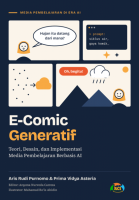
E-Comic Generatif Teori, Desain, dan Implementasi Media Pembelajaran Berbasis AI
Synopsis
SPESIFIKASI BUKU
Harga : Rp 65.000
Ukuran : 14,8 cm x 21 cm
Jumlah Halaman : 74 hal
Ketebalan Buku : 1 cm
ISBN : On Proses
Deskripsi Buku : Kecerdasan artifisial generatif telah mengubah cara pengetahuan diproduksi, dikemas, dan dikonsumsi. Dalam waktu kurang dari tiga tahun, guru dan siswa beralih dari sekadar pengguna media menjadi perancang media yang mampu menghasilkan teks, gambar, dan narasi visual melalui instruksi bahasa alami. Buku ini lahir dari kebutuhan untuk menjembatani dua tradisi yang selama ini berjalan terpisah. Tradisi pertama adalah kajian komik sebagai media pembelajaran yang telah diteliti sejak pertengahan abad ke-20. Tradisi kedua adalah perkembangan AI generatif yang bergerak cepat tetapi belum banyak dilandasi teori pembelajaran yang kokoh. Kami menawarkan sebuah kerangka utuh: landasan teoretis, prosedur desain, dan strategi implementasi e-comic generatif di kelas. Setiap bab disusun agar dapat dibaca oleh dosen, peneliti, mahasiswa calon guru, maupun guru di lapangan yang ingin memanfaatkan AI secara kritis, etis, dan bermakna.
REFERENSI :
Afandi, M. R. (2025). Digital comics (Webtoon) for EFL reading comprehension: Learner preferences and perceptual factors. Getsempena English Education Journal.
Aiken, L. R. (1985). Three coefficients for analyzing the reliability and validity of ratings. Educational and Psychological Measurement, 45(1), 131–142. https://doi.org/10.1177/0013164485451012
Ainsworth, S. (2006). DeFT: A conceptual framework for considering learning with multiple representations. Learning and Instruction, 16(3), 183–198. https://doi.org/10.1016/j.learninstruc.2006.03.001
Aleixo, P. A., & Sumner, K. (2017). Memory for biopsychology material presented in comic book format. Journal of Graphic Novels and Comics, 8(1), 79–88. https://doi.org/10.1080/21504857.2016.1219957
Alfarisi, M., et al. (2026). Development of super deformed digital manga comic media using Microsoft Paint to improve learning outcomes and learning motivation of junior high school students on the earth and solar system material. Integrated Science Education Journal.
Aliyar, M., et al. (2022). Incidental acquisition of Italian words from comic books. Reading in a Foreign Language.
Alon, L., et al. (2026). Bias and representation in AI-generated text-to-image in education: A systematic review. Computers and Education: Artificial Intelligence.
Apostolou, D., et al. (2023). Cognitive load approach to digital comics creation: A student-centered learning case. Applied Sciences.
Ardianto, T., et al. (2026). Generative AI ethno-digital comics enhancing socio-cultural awareness and value-based learning in elementary education. Journal of Educational Technology and Learning Creativity.
Avgerinou, M. D., & Pettersson, R. (2011). Toward a cohesive theory of visual literacy. Journal of Visual Literacy, 30(2), 1–19. https://doi.org/10.1080/23796529.2011.11674687
Badeo, J. M., et al. (2021). Use of comic-based learning module in physics in enhancing students’ achievement and motivation. Science Education International.
Baker, R. S., & Hawn, A. (2022). Algorithmic bias in education. International Journal of Artificial Intelligence in Education, 32(4), 1052–1092. https://doi.org/10.1007/s40593-021-00285-9
Bansal, H., et al. (2022). How well can text-to-image generative models understand ethical natural language interventions? In Proceedings of the 2022 Conference on Empirical Methods in Natural Language Processing.
Barve, S., et al. (2026). Social stereotypes in AI text-to-image generation. AI and Ethics.
Bedi, K. (2023). AI comics as art: Scientific analysis of the multimedia content of AI comics in education. In 2023 46th MIPRO ICT and Electronics Convention (MIPRO). IEEE.
Bender, E. M., Gebru, T., McMillan-Major, A., & Shmitchell, S. (2021). On the dangers of stochastic parrots: Can language models be too big? In Proceedings of the 2021 ACM Conference on Fairness, Accountability, and Transparency (pp. 610–623). ACM. https://doi.org/10.1145/3442188.3445922
Bianchi, F., Kalluri, P., Durmus, E., Ladhak, F., Cheng, M., Nozza, D., Hashimoto, T., Jurafsky, D., Zou, J., & Caliskan, A. (2023). Easily accessible text-to-image generation amplifies demographic stereotypes at large scale. In Proceedings of the 2023 ACM Conference on Fairness, Accountability, and Transparency (pp. 1493–1504). ACM. https://doi.org/10.1145/3593013.3594095
Black, P., & Wiliam, D. (1998). Assessment and classroom learning. Assessment in Education: Principles, Policy & Practice, 5(1), 7–74. https://doi.org/10.1080/0969595980050102
Brade, S., et al. (2023). Promptify: Text-to-image generation through interactive prompt exploration with large language models. In Proceedings of the 36th Annual ACM Symposium on User Interface Software and Technology. ACM.
Branch, R. M. (2009). Instructional design: The ADDIE approach. Springer.
Brooke, J. (1996). SUS: A “quick and dirty” usability scale. In P. W. Jordan, B. Thomas, B. A. Weerdmeester, & I. L. McClelland (Eds.), Usability evaluation in industry (pp. 189–194). Taylor & Francis.
Brookhart, S. M. (2013). How to create and use rubrics for formative assessment and grading. ASCD.
Brown, T. B., Mann, B., Ryder, N., Subbiah, M., Kaplan, J., Dhariwal, P., et al. (2020). Language models are few-shot learners. Advances in Neural Information Processing Systems, 33, 1877–1901.
Bruner, J. (1991). The narrative construction of reality. Critical Inquiry, 18(1), 1–21. https://doi.org/10.1086/448619
Byram, M. (1997). Teaching and assessing intercultural communicative competence. Multilingual Matters.
Byrd, D. (2024). The language teacher’s sidekick: Harnessing comics to motivate learners. Journal of Graphic Novels and Comics.
Casal-Otero, L., Catala, A., Fernández-Morante, C., Taboada, M., Cebreiro, B., & Barro, S. (2023). AI literacy in K-12: A systematic literature review. International Journal of STEM Education, 10, Article 29. https://doi.org/10.1186/s40594-023-00418-7
Castro-Alonso, J. C., Wong, R. M., Adesope, O. O., & Paas, F. (2021). Effectiveness of multimedia pedagogical agents predicted by diverse theories: A meta-analysis. Educational Psychology Review, 33, 989–1015. https://doi.org/10.1007/s10648-020-09587-1
Chan, C. K. Y., & Hu, W. (2023). Students’ voices on generative AI: Perceptions, benefits, and challenges in higher education. International Journal of Educational Technology in Higher Education, 20, Article 43. https://doi.org/10.1186/s41239-023-00411-8
Chandler, P., & Sweller, J. (1991). Cognitive load theory and the format of instruction. Cognition and Instruction, 8(4), 293–332. https://doi.org/10.1207/s1532690xci0804_2
Chee, H., et al. (2024). A competency framework for AI literacy: Variations by different learner groups and an implied learning pathway. British Journal of Educational Technology.
Chen, C.-H., & Yang, Y.-C. (2019). Revisiting the effects of project-based learning on students’ academic achievement: A meta-analysis investigating moderators. Educational Research Review, 26, 71–81. https://doi.org/10.1016/j.edurev.2018.11.001
Chi, M. T. H., & Wylie, R. (2014). The ICAP framework: Linking cognitive engagement to active learning outcomes. Educational Psychologist, 49(4), 219–243. https://doi.org/10.1080/00461520.2014.965823
Chiu, T. K. F. (2024). Future research recommendations for transforming higher education with generative AI. Computers and Education: Artificial Intelligence, 6, 100197. https://doi.org/10.1016/j.caeai.2023.100197
Chiu, T. K. F., Ahmad, Z., Ismailov, M., & Sanusi, I. T. (2024). What are artificial intelligence literacy and competency? A comprehensive framework to support them. Computers and Education Open, 6, 100171. https://doi.org/10.1016/j.caeo.2024.100171
Çiçek Şentürk, Ö., et al. (2023). Argumentation-supported educational comics as a teaching tool for environmental education. Environmental Education Research.
Clark, R. E. (1994). Media will never influence learning. Educational Technology Research and Development, 42(2), 21–29. https://doi.org/10.1007/BF02299088
Clark, J. M., & Paivio, A. (1991). Dual coding theory and education. Educational Psychology Review, 3(3), 149–210. https://doi.org/10.1007/BF01320076
Cohen, J. (1988). Statistical power analysis for the behavioral sciences (2nd ed.). Lawrence Erlbaum.
Cohn, N. (2013). The visual language of comics: Introduction to the structure and cognition of sequential images. Bloomsbury.
Cohn, N. (2020). Your brain on comics: A cognitive model of visual narrative comprehension. Topics in Cognitive Science, 12(1), 352–386. https://doi.org/10.1111/tops.12421
Cooper, G. (2023). Examining science education in ChatGPT: An exploratory study of generative artificial intelligence. Journal of Science Education and Technology, 32(3), 444–452. https://doi.org/10.1007/s10956-023-10039-y
Cotton, D. R. E., Cotton, P. A., & Shipway, J. R. (2024). Chatting and cheating: Ensuring academic integrity in the era of ChatGPT. Innovations in Education and Teaching International, 61(2), 228–239. https://doi.org/10.1080/14703297.2023.2190148
Council of Europe. (2020). Common European framework of reference for languages: Learning, teaching, assessment—Companion volume. Council of Europe Publishing.
Davis, F. D. (1989). Perceived usefulness, perceived ease of use, and user acceptance of information technology. MIS Quarterly, 13(3), 319–340. https://doi.org/10.2307/249008
Duncum, P. (2004). Visual culture isn’t just visual: Multiliteracy, multimodality and meaning. Studies in Art Education, 45(3), 252–264. https://doi.org/10.1080/00393541.2004.11651771
Dwivedi, Y. K., Kshetri, N., Hughes, L., Slade, E. L., Jeyaraj, A., Kar, A. K., et al. (2023). “So what if ChatGPT wrote it?” Multidisciplinary perspectives on opportunities, challenges and implications of generative conversational AI for research, practice and policy. International Journal of Information Management, 71, 102642. https://doi.org/10.1016/j.ijinfomgt.2023.102642
Eisner, W. (1985). Comics and sequential art. Poorhouse Press.
Fiorella, L., & Mayer, R. E. (2016). Eight ways to promote generative learning. Educational Psychology Review, 28(4), 717–741. https://doi.org/10.1007/s10648-015-9348-9
Gerlich, M. (2025). AI tools in society: Impacts on cognitive offloading and the future of critical thinking. Societies, 15(1), Article 6. https://doi.org/10.3390/soc15010006
Ginting, D., et al. (2024). The effects of digital storytelling on the retention and transferability of student knowledge. SAGE Open.
Gonsalves, C. (2024). Generative AI’s impact on critical thinking: Revisiting Bloom’s taxonomy. Journal of Marketing Education.
Goodfellow, I., Pouget-Abadie, J., Mirza, M., Xu, B., Warde-Farley, D., Ozair, S., Courville, A., & Bengio, Y. (2014). Generative adversarial nets. Advances in Neural Information Processing Systems, 27.
Green, M. C. (2021). Transportation into narrative worlds. In L. B. Frank & P. Falzone (Eds.), Entertainment-education behind the scenes: Case studies for theory and practice. Palgrave Macmillan.
Green, M. C., & Brock, T. C. (2000). The role of transportation in the persuasiveness of public narratives. Journal of Personality and Social Psychology, 79(5), 701–721. https://doi.org/10.1037/0022-3514.79.5.701
Green, M. J., & Myers, K. R. (2010). Graphic medicine: Use of comics in medical education and patient care. BMJ, 340, c863. https://doi.org/10.1136/bmj.c863
Groensteen, T. (2007). The system of comics (B. Beaty & N. Nguyen, Trans.). University Press of Mississippi.
Habeahan, E. (2025). Using English comics to teach reading in EFL classrooms. ELTR Journal.
Hake, R. R. (1998). Interactive-engagement versus traditional methods: A six-thousand-student survey of mechanics test data for introductory physics courses. American Journal of Physics, 66(1), 64–74. https://doi.org/10.1119/1.18809
Hao, Y., et al. (2022). Optimizing prompts for text-to-image generation. arXiv.
Hart, S. G., & Staveland, L. E. (1988). Development of NASA-TLX (Task Load Index): Results of empirical and theoretical research. In P. A. Hancock & N. Meshkati (Eds.), Human mental workload (pp. 139–183). North-Holland.
Published
September 29, 2026
Copyright (c) 2026 Perkumpulan Rumah Cemerlang Indonesia
Details about the available publication format: Pratinjau Buku
Pratinjau Buku
Physical Dimensions
Details about the available publication format: Beli Buku
Beli Buku


